络
Character Story & Explanation
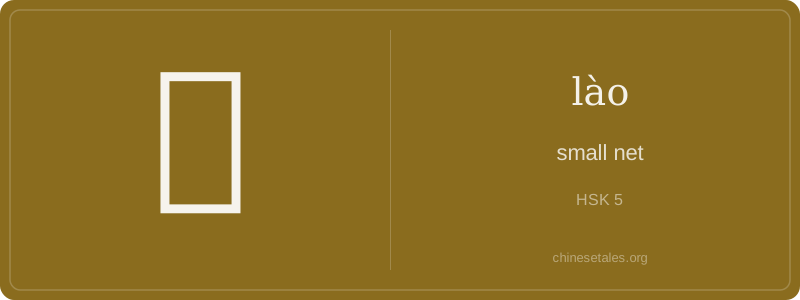
The earliest form of 络 appears on Warring States bamboo slips: a left-hand silk-thread radical (糸) paired with 口 (mouth) + 夂 (a foot descending), later standardized as 各. That ‘foot arriving at a mouth’ glyph hinted at ‘reaching a point of connection’ — like threads converging at a knot. Over centuries, the left side simplified from 糸 to 纟 (the modern silk radical), while 各 lost its foot-like stroke and became more angular, stabilizing into today’s 9-stroke form: two dots above, then three connected strokes (like a tiny ladder), topped by a hook and a final捺 (nà) sweep — mirroring how threads branch, meet, and anchor.
This visual logic shaped its meaning: from literal woven mesh in Han dynasty textile records, to anatomical ‘vessel networks’ in medical classics, and finally to abstract ‘systems’ by the Ming-Qing era. In the 12th-century Dream Pool Essays, Shen Kuo used 络 to describe capillary-like irrigation channels — proving its shift from object to organizing principle. Even today, when you say 人脉络 (rénmài luò), you’re invoking both blood vessels *and* social veins — a seamless blend of body, society, and language.
At its heart, 络 (lào) is all about *interconnection* — not just a physical net, but the delicate, often invisible threads that bind things together: nerves, blood vessels, computer networks, even gossip chains. The left radical 纟 (sī) screams 'silk' or 'thread', while the right side 各 (gè) originally meant 'to arrive' or 'each' — suggesting threads arriving at junctions, weaving into a system. This isn’t just ‘net’ as in fishing gear; it’s the *infrastructure of connection*.
Grammatically, 络 rarely stands alone in modern speech — it’s almost always in compounds like 网络 (wǎngluò, 'internet') or 脉络 (màiluò, 'veins/arteries; logical structure'). Note the pronunciation shift: it’s lào only in the rare standalone noun 'small net' (e.g., 铁络 — an archaic mesh tool), but luò in nearly all compound words. Learners often mispronounce 网络 as wǎnglào — a red flag that instantly marks you as a beginner!
Culturally, 络 embodies a deeply Chinese way of seeing the world: not as isolated objects, but as nodes in a relational web — be it familial ties (人络), acupuncture meridians (经络), or social influence (关系网). A common mistake? Assuming 络 means ‘network’ in the Western tech sense alone — it carries far more organic, biological, and even poetic weight. In classical texts like the Huangdi Neijing, 经络 refers to life-sustaining energy pathways — where medicine, philosophy, and metaphor all intertwine.