丝
Character Story & Explanation
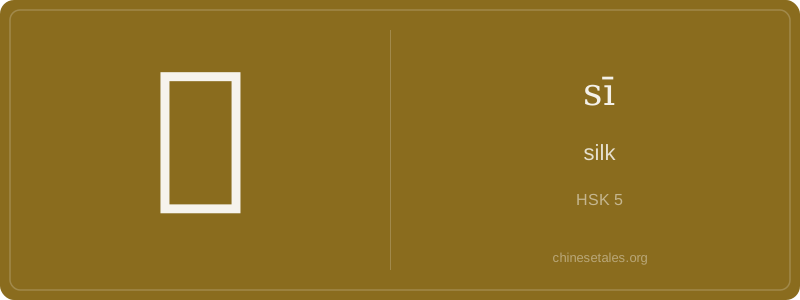
The earliest form of 丝 appears in bronze inscriptions as two parallel, wavy lines — a stylized depiction of twisted silk filaments drawn from silkworm cocoons. Over time, these evolved into the modern character’s elegant symmetry: two identical components (糸, the 'silk' radical) stacked vertically, each consisting of four strokes (丶、㇀、、丶), joined by the horizontal stroke 一 — the radical here isn’t ‘one’ but a unifying bar that binds the twin strands. The five-stroke structure isn’t arbitrary: it mirrors how real silk threads are spun — two filaments twisted together into one resilient cord.
This visual duality reflects its semantic journey: from literal silk (in oracle bone records describing tribute to Shang kings) to metaphorical continuity (Confucius used 丝 to describe the seamless transmission of ritual knowledge in the Analects). By the Tang dynasty, poets like Li Bai wove 丝 into imagery of longing — 'a thread of moonlight on my pillow' — cementing its role as the go-to character for anything fine, connected, and emotionally resonant. Even today, the shape whispers: 'two strands, one purpose.'
At its heart, 丝 (sī) isn’t just ‘silk’ — it’s the very idea of delicate continuity: fine, unbroken, shimmering threads that bind, connect, and sometimes entangle. To a native speaker, 丝 evokes tactile elegance — the cool slip of silk fabric, the subtle tension in a spider’s web, or even the faintest trace of emotion ('a thread of sorrow'). It carries connotations of refinement, fragility, and quiet persistence — values deeply embedded in Chinese aesthetics and philosophy.
Grammatically, 丝 is unusually versatile. As a noun, it means 'silk' (e.g., 丝绸 sīchóu). But as a measure word for thin, long things (like hair, wire, or smoke), it replaces 个 — you say 一丝头发 (yī sī tóufa), not *yī gè tóufa*. Crucially, it appears in fixed adverbial phrases like 一丝不苟 (yī sī bù gǒu, 'not the slightest bit careless') and 一丝一毫 (yī sī yī háo, 'the tiniest bit'), where it functions almost like a unit of infinitesimal quantity — a linguistic micro-measure that English lacks.
Learners often misread 丝 as merely decorative or archaic, missing its living metaphoric power. It’s not obsolete — it’s poetic precision. Confusing it with similar-looking characters (like 巾 or 师) derails comprehension, and over-translating it as 'silk' in idioms ('not one thread of care') flattens its nuance. Remember: in Chinese thought, even the smallest thread can hold up the sky — or unravel an empire.