编
Character Story & Explanation
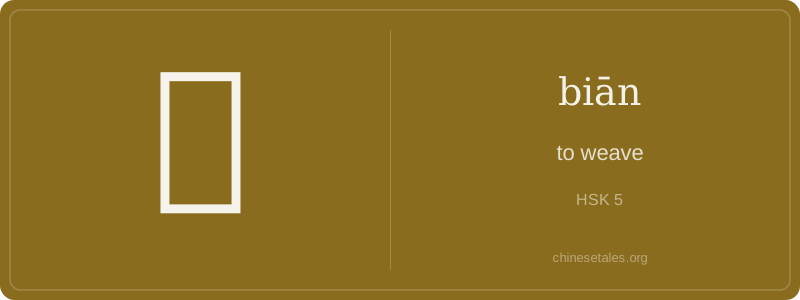
The earliest form of 编 appears in bronze inscriptions as two parallel vertical lines (representing threads or reeds) crossed by three horizontal strokes — like a simple loom grid. Over time, the left side evolved into the 纟 (silk) radical, anchoring its textile origin, while the right side solidified into 偏 — not for sound alone, but because 偏 (piān) originally meant ‘to incline’ or ‘deviate slightly’, hinting at the *deliberate, directional crossing* of strands. By the Han dynasty, the character had stabilized into its current 12-stroke form: four strokes for 纟 (the ‘silk’ radical), eight for 偏 — visually echoing the rhythm of weaving: pull, cross, tuck, repeat.
This physical act of interlacing became metaphorical early on: in the *Zuo Zhuan*, historians ‘编年’ (biān nián) — ‘weave years’ — to arrange events chronologically, treating time itself as warp and weft. Later, Buddhist sutras were ‘编集’ (compiled), and Ming dynasty officials ‘编户齐民’ — literally ‘weave households into equal people’, standardizing census records. The character never lost its core idea: imposing coherent, intentional structure onto raw material — whether silk, time, data, or society.
Imagine a master artisan in Suzhou, fingers flying as she interlaces golden silk threads into a brocade — not just weaving cloth, but weaving stories, status, and history. That’s 编 (biān): at its heart, it’s *intentional, patterned joining* — whether of threads, words, numbers, or people. It’s never random; it’s deliberate construction, often with authority or purpose. You’ll hear it in ‘编故事’ (to fabricate a tale) — not just ‘tell’, but *weave* a narrative so tightly it feels real.
Grammatically, 编 is wonderfully versatile: it can be a verb (‘编程序’ — to code), a noun (‘主编’ — chief editor), or even part of passive constructions (‘被编入’ — was assigned into). Crucially, it implies *agency and design*: if you 编 a list, you’re curating it; if you 编号, you’re imposing order. Learners often mistakenly use it for casual ‘making’ — like saying ‘编饭’ for ‘cook’ — but 编 doesn’t mean ‘make’ broadly; it means ‘structure systematically’. Think ‘weave’, not ‘do’.
Culturally, 编 carries subtle weight: to 编 history is to shape collective memory; to 编入户籍 is to officially integrate someone into society — a bureaucratic act with real-life consequences. A common slip is confusing 编 with 写 (write) — but 写 is about inscription; 编 is about architecture of meaning. Even in modern tech slang, ‘编译’ (compile) reflects this: turning human logic into machine-executable structure — still, at root, *weaving*.