缩
Character Story & Explanation
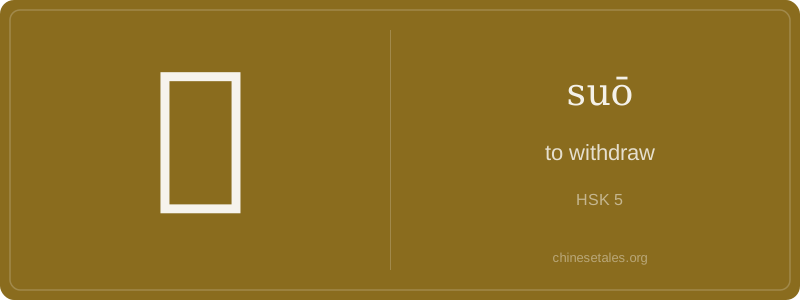
The earliest form of 缩 appears in bronze inscriptions as a composite: left side showed 糸 (a skein of silk, later simplified to 纟), and right side depicted 宿 — originally a pictograph of a person under a roof, suggesting shelter or containment. Over centuries, the right side evolved from 宿 (sù, meaning 'to lodge') into a stylized phonetic component that retained the suō sound but lost its original meaning. The left radical 纟 wasn’t decorative — it signaled action involving thread-like tension: think of pulling threads tight, coiling rope, or tightening fabric. Stroke by stroke, the character gained precision: the top dot became the ‘roof’ of 宿, the two horizontal strokes beneath formed the ‘person’ inside, and the final捺 (nà) stroke anchored the sense of downward compression.
This visual logic directly shaped its semantic journey. In the *Zuo Zhuan*, 缩 described ritual acts — 'drawing in' sacrificial ropes before burning them, symbolizing containment of spiritual energy. By the Tang dynasty, poets like Du Fu used 缩 to describe mountains 'drawing nearer' in mist (山色有无中,缩地入云中), blending spatial compression with poetic illusion. Even today, the character’s shape mirrors its function: the tight coil of 纟 on the left, the compressed, roofed space of 宿 on the right — a perfect glyph for 'pulling inward until contained'.
At its core, 缩 (suō) evokes a visceral sense of pulling inward — like a startled turtle drawing its head into its shell or a sweater shrinking in hot water. It’s not just ‘to withdraw’ abstractly; it carries physical tension, reduction, and sometimes even shame or hesitation. In modern usage, it’s versatile: as a verb (缩手 suō shǒu — 'to draw back one’s hand'), as part of compound verbs (缩小 suōxiǎo — 'to reduce in size'), and crucially, as a key component in aspect markers like 缩成 (suō chéng — 'to shrink into') or passive-like constructions (被缩了 bèi suō le — 'got shrunk'). Unlike English ‘withdraw’, 缩 rarely implies strategic retreat — more often involuntary contraction, spatial compression, or emotional recoil.
Grammatically, it loves companions: it almost never stands alone in formal speech. You’ll see it paired with 成 (chéng), 为 (wéi), or 进 (jìn) to mark resultative or directional complements (e.g., 缩进墙里 suō jìn qiáng lǐ — 'shrink into the wall'). Learners often mistakenly use it where 撤 (chè — 'to withdraw troops/forces') or 退 (tuì — 'to retreat, step back') belong — especially in political or military contexts. 缩 is bodily, intimate, and often irreversible: once you’ve 缩小差距 (suōxiǎo chājù — 'narrow the gap'), the effort feels physical, not diplomatic.
Culturally, 缩 appears in idioms that reveal Chinese attitudes toward restraint: 缩头乌龟 (suō tóu wūguī — 'turtle who draws in its head') mocks cowardice, while 缩衣节食 (suō yī jié shí — 'tighten clothes, cut food') reflects Confucian frugality. A classic mistake? Using 缩 for 'to retract a statement' — that’s 撤回 (chèhuí), not 缩回 (which means 'to pull back a limb', literally). Remember: 缩 always leaves a trace of physicality — if you can’t *feel* the shrinkage, you’re probably using the wrong character.