绳
Character Story & Explanation
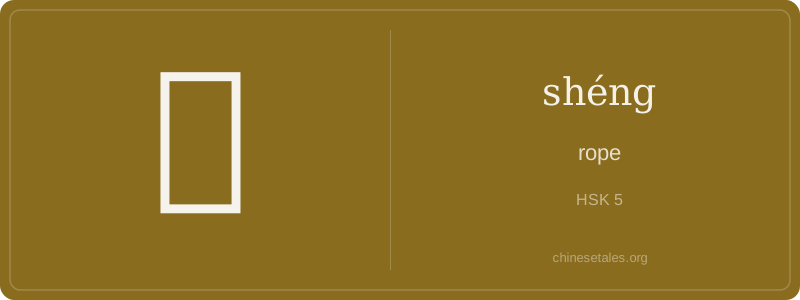
The earliest form of 绳 appears in Warring States bamboo slips as a stylized image of twisted strands — two parallel vertical lines (representing plied fibers) bound by three horizontal strokes (knots or wraps), later simplified and fused with the silk radical 纟 on the left. By Han dynasty seal script, the right component had morphed into 虫 — not because ropes attracted bugs, but because scribes borrowed the shape of 虫 (which itself evolved from a serpent pictograph) for its sound value, approximating the ancient pronunciation *dzyeng. Stroke by stroke, today’s 11-stroke 绳 crystallized: two dots (糹 top), three short strokes (糹 middle), then 虫 — six strokes total on the right, echoing the twisting motion of rope-making.
This visual evolution mirrors its semantic journey: from literal hemp cord (Zhou dynasty ritual texts mention ‘sacrificial ropes’ used to tether oxen) to metaphorical binding — Mencius wrote of rulers who ‘lose the people’s hearts when they snap the rope of virtue’ (失其繩墨). In the Book of Rites, 绳 appears in the phrase 绳墨 — literally ‘ink-line and rope’, referring to the carpenter’s tools that define true alignment, later extended to moral standards. So every time you write 绳, you’re tracing not just fiber, but millennia of ethical calibration.
At its heart, 绳 (shéng) is all about connection, constraint, and continuity — it’s not just ‘rope’ as a physical object, but a symbol of binding force: think moral restraint (‘the rope of conscience’), legal limits (‘bound by the rope of law’), or even poetic cohesion (‘a rope of verses’). The radical 纟 (sī), meaning ‘silk’ or ‘thread’, immediately signals this is a textile-related character — and indeed, ancient ropes were often braided from hemp, silk, or ramie fibers. Visually, the right side, 虫 (chóng, ‘insect’), is a phonetic clue (not semantic!) — it hints at pronunciation (shéng sounds faintly like chéng, an old variant), not bugs in your rope!
Grammatically, 绳 rarely stands alone as a noun in modern speech; it’s far more common in compounds (like 绳索 or 法绳) or in fixed idioms (e.g., 绳之以法 — ‘to bring to justice’). Learners often mistakenly use it like English ‘rope’ in verbs (e.g., *‘I rope the box’), but Chinese uses verbs like 捆 (kǔn, ‘to tie’) instead — 绳 itself doesn’t verbify. Also, while English says ‘tie with a rope’, Chinese prefers 捆上绳子 or simply 捆牢 — 绳 is the thing tied *with*, not the action.
Culturally, 绳 carries quiet gravity: in classical texts, it evokes Confucian self-discipline (‘reining oneself in like a horse with a rope’) and Daoist warnings against rigid control (‘a too-tight rope snaps’). A classic learner trap? Confusing it with 蝇 (yíng, ‘fly’) — same right-side 虫, but different left radical (虫 vs. 纟) and wildly different meanings. Remember: if there’s silk on the left, you’re holding rope — not chasing insects.