骂
Character Story & Explanation
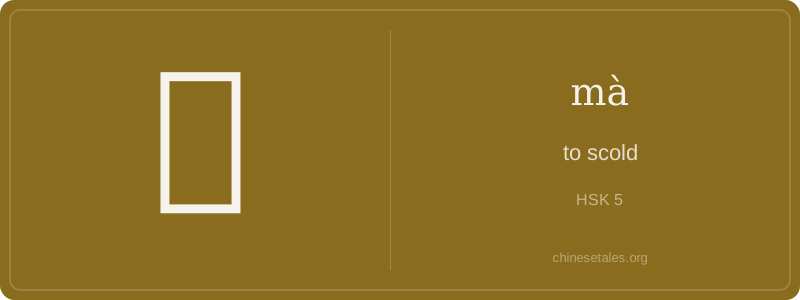
The earliest form of 骂 appears in bronze inscriptions as two components stacked: 口 (mouth) above 罒 (a variant of 网, 'net') — not literally a net, but an ancient pictograph representing a tightly woven mesh, symbolizing entanglement or restraint. Over centuries, 罒 simplified into the modern top component (which looks like ⺲), while 口 remained firmly rooted at the bottom — visually anchoring speech to the body. By the Han dynasty, the structure stabilized: nine strokes total — four for the net-like top, five for the mouth — embodying the idea of *words that trap or ensnare* the listener.
This visual metaphor deepened in meaning: 骂 wasn’t just yelling — it was *using language as a snare*, binding the target in shame or guilt. In the Mencius, the phrase ‘骂之不以道’ (scolding without principle) highlights its moral weight — effective 骂 required righteous intent, not just volume. Later, in Ming-dynasty vernacular fiction like Water Margin, 骂 became associated with righteous outlaws hurling insults at tyrants — transforming raw anger into social critique. The mouth remains literal; the ‘net’ evolved into abstract constraint — making 骂 one of Chinese’s most graphically honest verbs.
Imagine a bustling Beijing alley at noon: Auntie Li stands arms akimbo, voice sharp as broken glass, berating her neighbor for letting his dog pee on her freshly swept steps. Her mouth is wide open — you can almost see the heat waves rising off her words. That’s 骂 (mà): not just ‘to scold’, but to unleash loud, direct, emotionally charged verbal reprimand — often with anger, sometimes with humor, always with mouth-wide-open force. It’s visceral, physical, and rarely polite.
Grammatically, 骂 is a transitive verb that *requires* an object: you must骂 someone or something (e.g., 骂他, 骂老板, 骂天气). You can’t say ‘I’m scolding’ without saying *whom*. It also appears in serial verb constructions (他骂完就走了) and passive forms (被老板骂了), which learners often omit the ‘by-phrase’ in — a subtle but critical error. Unlike the gentler 责备 (zébèi) or formal 批评 (pīpíng), 骂 implies emotional intensity and informal, often public, confrontation.
Culturally, 骂 carries strong connotations of losing face — both for the speaker (if seen as uncontrolled) and the target (if publicly humiliated). In classical texts, it appears in satirical poetry like Du Fu’s lines mocking corrupt officials — where 骂 is wielded as moral weapon, not mere rudeness. Learners mistakenly use it for mild corrections (‘Don’t do that!’) — but that’s 告诉 (gàosu) or 提醒 (tǐxǐng); 骂 belongs to the thunderclap, not the tap on the shoulder.