英
Character Story & Explanation
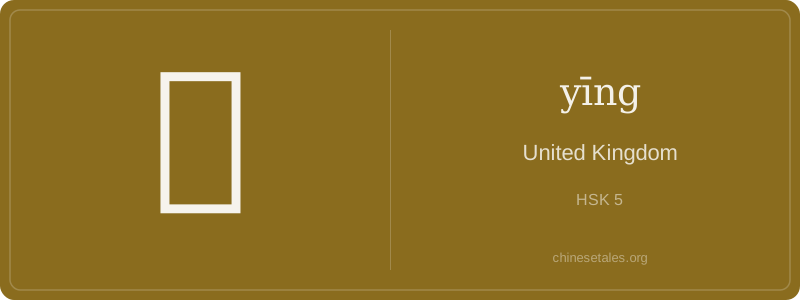
The earliest form of 英 appears in bronze inscriptions around 1000 BCE: a stylized plant (the radical 艹) above two horizontal strokes and a downward stroke — resembling a flowering plant with blossoms and seed pods. Over centuries, the top simplified into the standard grass radical 艹, while the bottom evolved from a pictograph of ‘flower head + seeds’ into the modern 勹+一+丿 shape (resembling a curved container holding something precious). By the Han dynasty, the character was standardized with eight strokes — clean, balanced, and unmistakably botanical.
This floral origin is key: 英 originally meant ‘blossom’, ‘flower’, or ‘the finest part of a plant’ — symbolizing excellence, brilliance, and prime quality. In the *Classic of Poetry* (Shījīng), 英 describes the radiant stamens of flowers; by the Warring States period, it metaphorically extended to human virtues — hence 英才 (yīngcái, ‘outstanding talent’) and 英雄 (yīngxióng, ‘hero’). When Western powers arrived, Chinese scholars chose this character — already rich with connotations of refinement and preeminence — to render ‘England’ and ‘English’, lending cultural gravitas to the foreign entity. The flower didn’t wilt; it bloomed into diplomacy.
Think of 英 not as a dry geopolitical label like 'UK' on a passport stamp, but as China’s linguistic equivalent of the British royal crown: elegant, historically weighty, and slightly anachronistic in daily use. Its core meaning isn’t just ‘United Kingdom’ — it’s ‘excellence’, ‘heroic spirit’, or ‘refined essence’, like the ‘-ing’ in ‘outstanding’ or the ‘-ent’ in ‘brilliant’. That’s why 英 is always paired — you’ll never say *‘I go to 英’*; you say 英国 (Yīngguó, ‘England-state’) or 英语 (Yīngyǔ, ‘England-speech’). It’s a borrowed honorific, not a standalone noun.
Grammatically, 英 functions exclusively as a prefix in compound nouns — never as a verb, adjective, or standalone subject/object. Learners often mistakenly try to use it like ‘UK’ in English sentences (e.g., *‘I visited 英 last summer’*), but that’s ungrammatical; you must say 我去年夏天去了英国. Also, 英 never means ‘British people’ — that’s 英国人 (Yīngguó rén). And crucially: 英 ≠ England alone. It stands for the entire United Kingdom (including Scotland, Wales, Northern Ireland), unlike ‘Eng’ in English abbreviations.
Culturally, 英 carries quiet prestige — it’s used in formal contexts (英方代表, ‘UK delegation’), academic settings (英美文学, ‘Anglo-American literature’), and even poetic idioms (英雄, yīngxióng, ‘hero’ — literally ‘excellent + mighty’). A common slip? Writing 英 for ‘English’ when speaking informally — native speakers say ‘英文’ (Yīngwén) for ‘English language’, never just ‘英’. The character demands its full compound — respect, like addressing royalty by title, not nickname.