虚
Character Story & Explanation
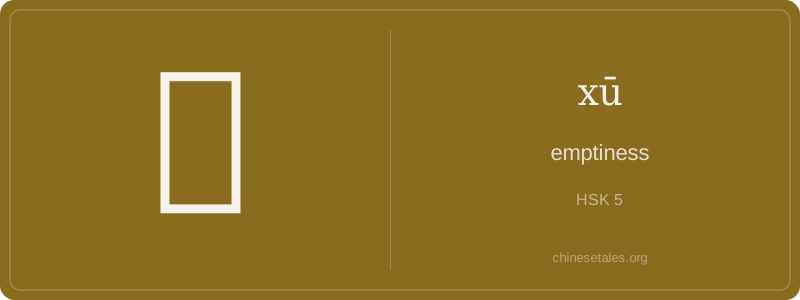
The earliest form of 虚 appears in bronze inscriptions as a complex pictograph: at top, a stylized tiger head (虍, the radical), representing watchfulness or danger; below, a kneeling person (丘 or 丘-like element) with arms raised, perhaps in ritual submission—or more plausibly, a figure standing on a mound (丘) beneath a roof (宀), suggesting a sacred, open-air altar space. Over time, the tiger-head radical stayed firm at the top, while the lower part simplified into 丘 (hill/mound) + 业 (originally 'sacrificial stand' or 'platform')—not 'industry', but a ritual base. By the seal script era, the shape stabilized: 虍 + 丘 + 业 = 'a sacred space deliberately left unoccupied'—emptiness as intentional, reverent, functional.
This visual logic shaped its semantic journey. In the Dao De Jing, Laozi praises the usefulness of the hollow in a wheel hub or the empty space in a vessel—'thirty spokes share one hub; it is because of the hole that the cart can move.' 虚 became the philosophical anchor for that insight. By the Han dynasty, it entered medicine (Huangdi Neijing) to describe deficiency states—'emptiness' not as absence, but as *insufficient nourishment*. Its tiger-head radical hints at danger: unchecked 虚 weakens the body’s defenses, just as a tiger might exploit vulnerability. So 虚 isn’t passive blankness—it’s a dynamic, charged condition requiring discernment and care.
Think of 虚 (xū) as Chinese philosophy’s version of a Zen koan made visible: it doesn’t just mean 'emptiness'—it means *productive* emptiness, like the hollow center of a bamboo flute that makes music possible, or the negative space in a Japanese ink painting that gives the image breath. In English, 'empty' often carries negative weight ('empty calories', 'empty promises'), but 虚 is neutral or even virtuous—it’s the fertile void from which creativity, humility, and qi flow.
Grammatically, 虚 shines in compound words and abstract constructions—not as a standalone verb, but as a modifier or noun root. You’ll rarely say 'I am xū' alone; instead, you’ll say 虚心 (xū xīn, 'humble heart') or 虚假 (xū jiǎ, 'false'). It also appears in grammatical structures like 虚词 (xū cí, 'function words'—e.g., prepositions, conjunctions), where its 'non-substantive' nature is literal: these words carry no concrete referent, only relational meaning. Learners often misapply it as a direct synonym for 'fake'—but while 虚假 means 'false', 虚 alone isn’t 'fake'; it’s the *condition* underlying falsity (lack of substance), not the moral judgment itself.
Culturally, 虚 embodies Daoist and medical wisdom: in Traditional Chinese Medicine, 虚证 (xū zhèng) refers to 'deficiency patterns'—not 'weakness' per se, but an imbalance where vital energy (qi) or blood is insufficient. A common learner trap? Confusing 虚 with 空 (kōng), which denotes physical vacancy (an empty room) or Buddhist 'emptiness' (śūnyatā). 虚 is more subtle: it implies *lack of authentic substance*, whether in argument, health, or character—and that nuance is everything.