话
Character Story & Explanation
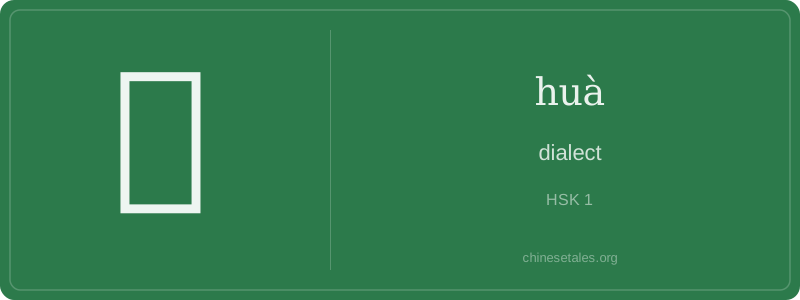
The earliest form of 话 appears in bronze inscriptions around 1000 BCE as a compound: the left side was 言 (yán), a pictograph of an open mouth with a tongue-like stroke, representing 'speech'; the right side was 化 (huà), which originally depicted a person transforming — two facing stick-figures, one slightly bent, suggesting change or influence. Together, they conveyed 'speech that transforms' — words with power to persuade, instruct, or shift reality. Over centuries, 言 simplified into the modern radical 讠 (a stylized mouth), while 化 lost its second person figure and became the clean, flowing shape we know today — eight strokes total: two for the speech radical, six for the 'transformation' component.
This origin explains why 话 isn’t just 'words' — it’s *influential* speech: the kind that spreads, adapts, and takes root in new places. By the Han dynasty, 话 had narrowed to mean 'spoken language' — especially local varieties — appearing in texts like the Fangyan (c. 1st c. CE), China’s first dialect dictionary, where it labels regional speech forms. The visual link remains: the 'transformation' part (化) literally embodies how language bends and reshapes itself across geography and time — making 话 a perfect character for 'dialect'.
Imagine you’re sitting in a teahouse in Chengdu, and two locals start chatting — their rapid, melodic Sichuanese flows like water. You catch the word huà — not as 'speech' in the abstract, but specifically as 'dialect', as in Sìchuān huà. That’s 话’s everyday heartbeat: it’s not just 'words' or 'talk', but the living, breathing, regionally flavored *way* people talk — the accent, rhythm, slang, and soul of a place. It carries warmth, identity, and sometimes gentle teasing ('Oh, your Beijing huà is so crisp!').
Grammatically, 话 is almost always a noun — never a verb — and it’s nearly always paired: shuō huà (to speak), zhōngwén huà (Mandarin), guǎngdōng huà (Cantonese). Learners often mistakenly use it alone ('I speak 话') — but no! You say wǒ shuō zhōngwén, not wǒ shuō huà; 话 needs context or a modifier. Think of it like 'dialect' in English: you wouldn’t say 'I speak dialect' — you say 'I speak *Cantonese dialect*'. So 话 almost always appears *after* a place name or language label.
Culturally, calling something a 'huà' subtly acknowledges linguistic diversity within China — it’s respectful to refer to non-Mandarin varieties as 'dialects' (even if linguists debate that term), and using the right one signals belonging. A common slip? Confusing 话 with 说 (shuō) — the verb 'to speak'. But 话 isn’t the action; it’s the *thing spoken*, especially its regional flavor. And yes — even though it means 'dialect', it’s HSK 1 because it’s foundational for naming languages and talking about communication!