补
Character Story & Explanation
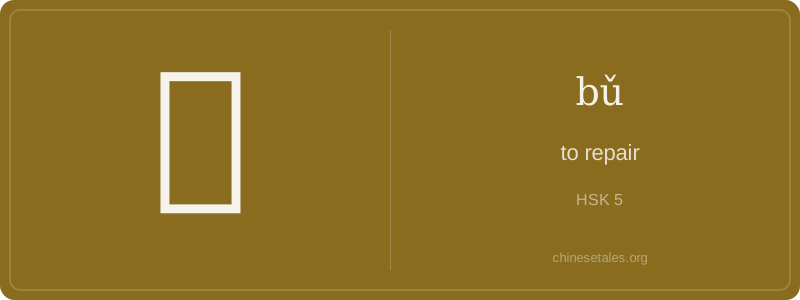
The earliest form of 补 appears in bronze inscriptions as a combination of 衣 (clothing) and 卜 (divination stalks)—not random! In Shang dynasty ritual practice, priests would mend torn ceremonial robes *before* divination, believing a flawed garment could disrupt spiritual communication. The original pictograph showed a cloth with visible stitches (the top 衤 radical) and a卜-like mark indicating ritual precision. Over centuries, the卜 evolved into 凵 (a container shape), then simplified to the modern 又 (‘again’ hand radical), preserving the idea of *repeated, deliberate action*—like stitching again and again until whole.
By the Han dynasty, 补 expanded beyond textiles: Sima Qian used it in the Shiji to describe officials ‘repairing’ administrative gaps (补吏缺), and Tang poets wrote of 补天 (bǔ tiān — ‘mending the sky’), referencing the myth of Nüwa. That celestial metaphor stuck—today, 补 still carries poetic weight: 补心 (bǔ xīn, ‘nourish the heart’) echoes ancient medical texts linking emotional balance to physical wholeness. Visually, the seven strokes map perfectly to this history: the first two strokes draw the robe’s collar (衤), the next three sketch the hand at work (又), and the final two strokes are the ‘stitches’ holding it together—literally, a character built from care.
At its heart, 补 (bǔ) is about restoration—not just physical mending, but filling gaps in time, knowledge, health, or relationships. Think of it as the Chinese linguistic equivalent of hitting ‘Ctrl+Z’ and then adding a better patch: it implies intentional, often thoughtful, correction. The character carries warmth, not blame; you don’t ‘blame’ a torn shirt—you 补 it. That nuance matters: 补 never means ‘punish’ or ‘penalize’ (a common beginner assumption), nor does it imply failure—it’s proactive care.
Grammatically, 补 is wonderfully flexible: it can be a verb (补衣服, bǔ yīfu — 'to mend clothes'), a noun (营养补, yíngyǎng bǔ — 'nutritional supplement'), or even part of compound verbs like 补上 (bǔ shàng — 'to make up for', e.g., 补上一节课, 'make up a class'). Crucially, it pairs with 得 (de) to form 补得… (‘can repair/make up so well that…’) and often appears in passive constructions like 被补好了 (bèi bǔ hǎo le — ‘has been repaired’). Learners frequently overuse 补 where 修 (xiū) or 修好 (xiū hǎo) would sound more natural for mechanical repairs—e.g., we say 修电脑, not 补电脑.
Culturally, 补 reflects a deep Confucian value: harmony isn’t static perfection—it’s dynamic maintenance. You 补关系 (bǔ guānxi — mend relationships), 补课 (bǔ kè — make up lessons), even 补觉 (bǔ jiào — ‘repair sleep’, i.e., catch up on rest). This isn’t emergency triage—it’s dignified, ongoing stewardship. A classic mistake? Using 补 instead of 填 (tián) for ‘filling blanks’ (as in forms)—that’s 填空, not 补空. Also, note that 补 is rarely used alone in speech; it almost always appears in compounds or with an object.