裹
Character Story & Explanation
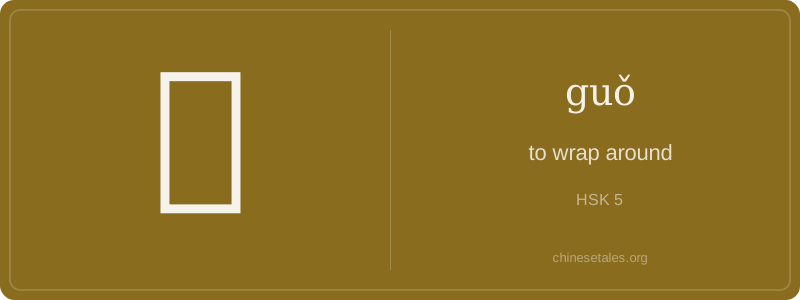
The earliest form of 裹 appears in bronze inscriptions as a vivid pictograph: a kneeling figure () with arms crossed over the chest, enclosed by a curved line representing cloth or binding — literally 'a person swaddled'. Over centuries, the figure simplified into the top component 亠 (a roof-like cover), the crossed arms became 儿 (a stylized bent body), and the enclosing curve evolved into 衣 (clothing) at the bottom — turning the whole character into 'clothing wrapping a person'. By the Han dynasty, the 衣 radical wasn’t just decorative; it anchored the meaning firmly in bodily covering, not abstract containment.
This bodily origin explains why 裹 feels so physical in classical texts: In the *Zhuangzi*, clouds are said to 裹天地 (wrap heaven and earth), evoking a living, breathing embrace — not mechanical enclosure. Even today, 裹 never means 'pack' or 'box'; it preserves that ancient sense of soft, continuous, skin-close envelopment. Its stroke count (14) mirrors the care required: every curve and fold matters — no shortcuts in true wrapping.
Think of 裹 (guǒ) not as a dry 'to wrap' verb, but as the Chinese concept of *enfolding* — gentle, complete, almost protective. It’s not about taping a box shut (that’s 包), but about something soft and continuous spiraling around: silk around a body, mist around mountains, or tradition wrapping around modern life. The feeling is intimate, immersive, and often slightly poetic — you’ll rarely hear it in casual 'wrap this burrito' talk; it’s more 'the scent of plum blossoms裹着春风' (wrapped in spring breeze).
Grammatically, 裹 is almost always used in compound verbs like 裹住 (guǒ zhù, 'to wrap tightly'), 裹挟 (guǒ xié, 'to sweep along/forcefully carry with'), or passively as 裹着 (guǒ zhe, 'wrapped in'). Crucially, it’s rarely transitive without a complement — you won’t say 'I裹the gift'; you say 'I裹住the gift' or 'the gift is裹着red paper'. Learners often mistakenly use it alone like English 'wrap', leading to unnatural sentences.
Culturally, 裹 carries subtle weight: 裹挟 implies coercion masked as unity ('public opinion裹挟the minority'), while 裹足不前 (guǒ zú bù qián, 'feet wrapped, unable to advance') is a classic idiom for paralyzing conservatism. A common mistake? Confusing it with 果 (guǒ, 'fruit') — same sound, totally different world. Remember: 裹 has 衣 (clothing) at its heart — it’s about *covering the body*, not harvesting trees.