语
Character Story & Explanation
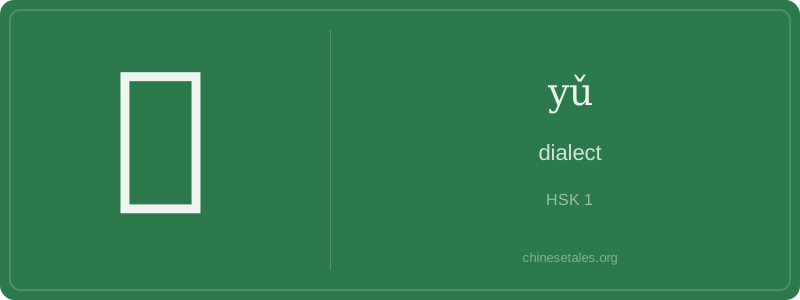
The earliest form of 语 appears in bronze inscriptions around 1000 BCE: a combination of 言 (a stylized mouth with tongue protruding, later simplified to 讠) and 吾 (wú), which itself depicted a spearhead + mouth — suggesting 'my speech' or 'what I declare'. Over time, 言 lost its full pictorial form, shrinking into the two-stroke radical 讠 on the left, while 吾 condensed into the right side: 五 (wǔ) — five — whose shape (× shape inside square) was phonetic, hinting at pronunciation. By the Han dynasty, the character stabilized as 语: left side 'speech', right side 'sound clue'.
This evolution reflects how Chinese writing prioritizes sound-meaning fusion: 吾 wasn’t chosen for 'five' meaning, but because its ancient pronunciation resembled yǔ. Confucius used 语 in the Analects (《论语》 Lúnyǔ — 'Analects') — literally 'discussions/collected sayings' — where 语 implies spoken wisdom passed down orally, not formal texts. Even today, the character’s structure whispers its origin: 'speech' (讠) + 'sound' (吾 → 五), making 语 the written echo of a voice heard, remembered, and localized.
Think of 语 (yǔ) like the 'dialect' button on a streaming service — not just language in general, but the specific flavor of speech that tells you *where* someone’s from, *who* they are, and even *how much* they trust you. In Chinese, 语 rarely stands alone meaning 'language' — it’s almost always paired: Mandarin is 普通话 (pǔtōnghuà), not 'pǔtōng yǔ'; but when we say 方言 (fāngyán) or 吴语 (Wúyǔ), that 语 pinpoints a living, breathing regional voice — like hearing Boston vs. Birmingham English in one word.
Grammatically, 语 is a noun suffix, never a verb — so you’ll never say 'I yǔ' (that’s for 说 shuō). It appears in compounds (汉语, 英语, 粤语), and crucially, in HSK 1, it only shows up in fixed phrases like '中文' (Zhōngwén) or '英语' (Yīngyǔ) — never as a standalone 'yǔ' meaning 'dialect'. Learners often mistakenly use it like English 'language' ('I study Chinese yǔ'), but no — it’s always 汉语, never just 'yǔ'.
Culturally, 语 carries quiet hierarchy: 普通话 is 'common speech', while 吴语 or 闽语 aren’t 'lesser' — they’re linguistically rich, centuries-old systems. Yet many learners assume 语 = 'language' broadly; in truth, it evokes oral tradition, local identity, and subtle social signaling — like saying 'Texan' instead of 'American English'. Also, watch that pronunciation: yù appears in rare literary verbs like 语 (yù) meaning 'to speak' (e.g., 不语 bù yù — 'refuses to speak'), but that’s HSK 4+ territory — ignore it for now!