贸
Character Story & Explanation
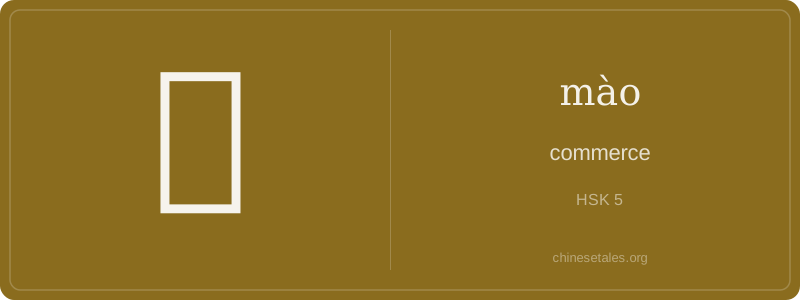
The earliest form of 贸 appears in Warring States bamboo slips as a combination of 貝 (a stylized shell — ancient currency) and 卯 (an ancient pictograph for a door hinge or interlocking joint, later standardized as the 10th Earthly Branch). The original shape wasn’t ‘buying and selling’ per se, but rather *mutual binding*: two parties locking terms — like sealing a contract with shells as deposit. Over centuries, 卯 simplified from a symmetrical double-‘x’ shape into today’s top component (丿 + 丨 + 乚), while 贝 retained its distinctive ‘open clam’ outline — nine strokes total, counting the inner dot as the ‘pearl’ of value.
This visual contract evolved into semantic weight: by the Han dynasty, 贸 explicitly meant ‘exchange of goods of equal value’ — distinct from 买 (buy) or 卖 (sell), which imply unilateral action. In the *Shuōwén Jiězì* (121 CE), Xu Shen defines it as ‘exchange without deceit’ — stressing fairness and reciprocity. Its appearance in classical phrases like ‘贸然’ (originally ‘trading boldly’, later ‘acting rashly without due consideration’) reveals how the character absorbed moral gravity: true trade required preparation, just as true action required forethought.
Think of 贸 (mào) as China’s ancient 'trade badge' — not a modern logo, but a carved seal stamped onto silk bales and bronze coins over 2,500 years ago. Unlike English ‘commerce’, which feels abstract and bureaucratic, 贸 carries visceral energy: it implies active exchange, negotiation, even risk — like haggling in a bustling Tang dynasty market where merchants from Persia, Sogdiana, and Chang’an jostled over spices, horses, and lacquerware. It’s never passive; you don’t ‘have’ commerce — you *do* 贸.
Grammatically, 贸 almost never stands alone. It’s the sturdy backbone of compound nouns (like 贸易 or 外贸), rarely appearing as a verb without a prefix or suffix. Learners often wrongly try to say *‘wǒ mào shāng’* (I commerce) — but that’s ungrammatical. Instead, it appears in structures like ‘从事外贸’ (engaged in foreign trade) or ‘贸易额’ (trade volume). It also appears in formal verbs like ‘贸然’ (to act rashly — literally ‘trade-then-suddenly’!), showing how its core idea of bold, consequential action spilled into metaphor.
Culturally, 贸 hints at China’s long ambivalence toward merchants: historically ranked lowest among the ‘four occupations’, yet absolutely indispensable. That tension lives in the character — its radical 贝 (shell money) honors economic reality, while its top component (卯) subtly evokes timing and precision (ancient timekeeping used the ‘mao’ branch). A common mistake? Confusing it with 易 (yì, ‘exchange’) — but 易 is about effortless swapping, while 贸 implies scale, structure, and stakes.