请
Character Story & Explanation
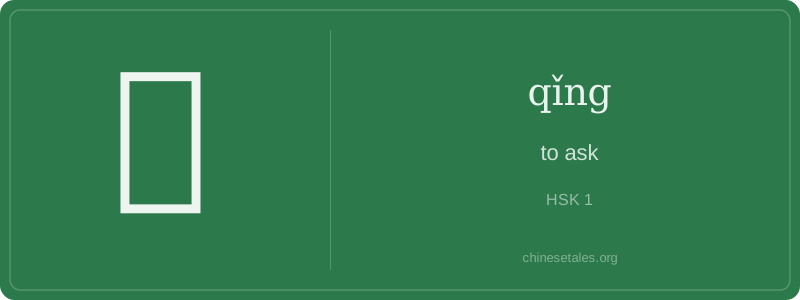
The earliest form of 请 appears in bronze inscriptions as ⿰言青 — combining 言 (speech) on the left and 青 (qīng, originally depicting a plant sprouting from a well — later simplified to mean ‘blue/green’ but phonetically borrowed here). The right side 青 wasn’t chosen for color; it served as a *phonetic clue*, approximating the ancient pronunciation *tsʰeŋ*. Over centuries, the complex bronze form streamlined: 言 shrank into the modern 讠 radical (two strokes: 丶 and 乛), while 青 lost its top grass radical (艹) and bottom ‘well’ (円), settling into today’s 10-stroke structure — a perfect visual balance of speech (left) and sound (right).
This character first appeared in the Zuo Zhuan (c. 4th century BCE) meaning ‘to request formally’ — often in diplomatic contexts: ‘The Duke of Qi qǐng an audience with the Zhou king.’ Its semantic core has held steady for 2,500 years: initiating respectful interaction through speech. Intriguingly, the phonetic component 青 also carried connotations of freshness and vitality — subtly reinforcing that a sincere 请 isn’t rote etiquette, but a lively, earnest offering of goodwill.
Imagine you’re at a Beijing teahouse, bowing slightly as you lift your cup and say qǐng — not just ‘please’, but an elegant, almost ceremonial invitation: ‘May I offer you tea?’ That’s the soul of 请: it’s never just a polite filler like English ‘please’. It’s an active, respectful *initiation* — asking for permission, inviting action, or requesting service. You don’t say 请 after a request (‘pass the salt, please’); you place it *before*: 请坐 (qǐng zuò — ‘be seated, I invite you’) or 请问 (qǐng wèn — ‘I respectfully ask…’).
Grammatically, 请 is a verb — not a particle — so it takes subject-object order and can be modified: 我可以请您帮忙吗?(Can I ask you for help?) It also forms the cornerstone of formal speech: 请 + verb is how you make any request sound courteous and non-demanding. Learners often overuse it like English ‘please’, or worse, omit it when context demands deference — saying 吃饭吧 (let’s eat) to your boss instead of 请吃饭 (‘I invite you to eat’) can accidentally sound brusque or even rude.
Culturally, 请 carries Confucian weight: it marks hierarchy, humility, and relational care. In classical texts like the Book of Rites, 请 was used in ancestral rituals — offering reverence before action. Today, its tone shifts subtly: 请进 (come in) feels warm; 请出示证件 (please show ID) feels official but still civil. A common mistake? Using 请 with imperatives toward peers — it can unintentionally sound condescending unless softened with 好吗 or 吧. Remember: 请 isn’t politeness-as-ornament — it’s politeness-as-intention.