踩
Character Story & Explanation
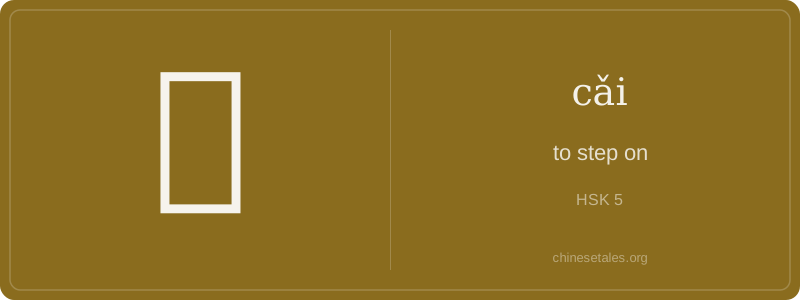
The earliest form of 踩 appears in seal script as a combination of 足 (zú, 'foot', the radical) on the left and 采 (cǎi, 'to gather, pluck') on the right — not as a phonetic loan, but as a semantic-phonetic compound. The 足 side vividly depicts a bent leg with five toes (the top dot and four strokes below), while 采 originally showed a hand picking fruit from a tree — suggesting 'gathering with effort'. Over time, the hand became stylized into the 'tree + hand' shape we see today, and the whole character solidified into its current 15-stroke structure: the left 'foot' radical anchoring the meaning, the right 'gather' component hinting at both sound (cǎi) and the active, pressing motion involved.
By the Han dynasty, 踩 had crystallized around the sense of 'pressing down with the foot', appearing in texts like the *Shuōwén Jiězì* as 'to tread firmly, to crush underfoot'. Classical poets used it for visceral imagery — Du Fu wrote of soldiers '踩着冻土' (cǎi zhe dòng tǔ, 'stepping on frozen earth'), evoking cold, hardness, and exhaustion. The visual logic remains striking: the foot (足) literally 'gathers' or 'harvests' contact — not by lifting, but by descending with force. This dual-root origin — foot + gathering effort — makes 踩 uniquely tactile among stepping verbs.
At its heart, 踩 (cǎi) is all about grounded force — not gentle stepping, but deliberate, often emphatic, pressure with the foot. Think stomping on a bug, squashing grapes barefoot, or accidentally stepping on someone’s toe in a crowded subway: it carries weight, intention, and sometimes consequence. Unlike neutral verbs like 走 (zǒu, 'to walk') or 站 (zhàn, 'to stand'), 踩 implies contact, compression, and often a change in state — something gets flattened, disturbed, or even damaged.
Grammatically, 踩 is a transitive verb that almost always takes a direct object ('踩 grass', '踩刹车'), and it frequently appears in resultative constructions like 踩碎 (cǎi suì, 'step-and-break') or 踩烂 (cǎi làn, 'step-and-mash'). Learners often mistakenly use it where English says 'step *onto*' — but in Chinese, that’s usually 上 (shàng) or 登 (dēng); 踩 emphasizes the downward action *on* a surface, not just arrival. Also, don’t confuse it with 踩油门 (cǎi yóumén) — yes, you ‘step on’ the gas pedal, but this usage is idiomatic, not literal.
Culturally, 踩 carries subtle connotations of intrusion or disrespect — 踩到别人的脚 (cǎi dào biéren de jiǎo) isn’t just physical; it can imply social clumsiness. In internet slang, 踩 has taken on a playful, metaphorical life: '踩楼' (cǎi lóu) means replying to a comment thread (like stepping up floors), and '被踩' (bèi cǎi) jokingly means 'got downvoted'. Watch out: mispronouncing it as cāi (like 猜) turns your sentence into 'I guess the ground' — a hilarious but fatal error.