辩
Character Story & Explanation
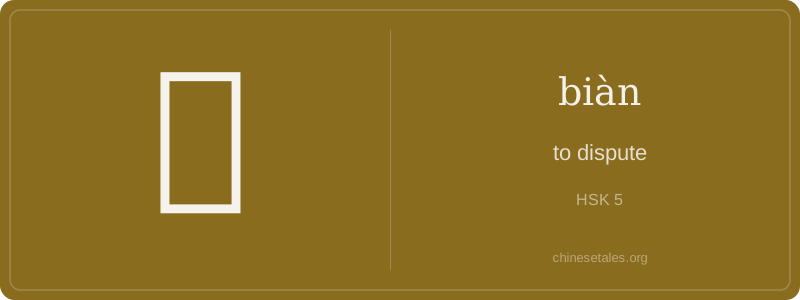
The earliest form of 辩 appears in Warring States bamboo slips as two ‘speech’ components (言) flanking a central ‘辛’—not a pictograph of speech itself, but a symbolic layout: two opposing voices (言 + 言) clashing over the ‘sharp, painful’ radical 辛, which originally depicted a chisel or axe used in ancient punishments. Over centuries, the left 言 simplified into the modern ‘讠’ (speech radical), while the right 言 merged with 辛 into the lower half—16 strokes capturing tension, precision, and consequence.
This visual duality shaped its meaning: from early texts like the Zuo Zhuan, 辩 meant ‘to distinguish truth from falsehood through rigorous speech’, evolving by Han times into formal legal defense and philosophical argumentation. Mencius famously said, ‘君子必辩’ (A gentleman must dispute)—not to win, but to uphold righteousness. The 辛 radical isn’t decorative: it signals that true disputation is exacting, even uncomfortable—like carving truth with a chisel. No wonder modern courts still use 辩护 (biànhù, ‘legal defense’): the ‘chisel’ remains central.
Imagine a heated university debate club meeting in Beijing: students lean forward, eyes sharp, voices rising—not to shout down opponents, but to biàn—to dissect logic, cite evidence, and refine truth through structured verbal sparring. That’s 辩 in action: it’s not angry arguing, but rigorous, respectful disputation—a core Confucian and legal virtue where clarity emerges only after thorough examination. It carries intellectual weight, never rudeness.
Grammatically, 辩 is almost always a verb, rarely used alone—it appears in compounds like 辩论 (biàn lùn, 'debate') or 自辩 (zì biàn, 'self-defense'). You won’t say *‘I 辩 him’*; instead, you *biàn lùn yí gè wèn tí* (debate an issue) or *zài fǎtíng shàng zì biàn* (plead your own case in court). Learners often mistakenly use it as a transitive verb with a direct object like English ‘argue someone’—but 辩 requires prepositions (e.g., 为…辩, ‘defend for…’) or compound framing.
Culturally, 辩 reflects China’s deep-rooted value of ‘truth through contestation’—seen in classical texts like the Mencius, where sages ‘辩而明之’ (clarify through disputation). A common slip? Confusing it with 辨 (to distinguish) or 辫 (braid)—both sound identical but lack 辩’s legal-logical gravity. Misuse can turn ‘I defended my thesis’ into ‘I braided my thesis’—awkward, yes, but hilariously revealing of how much meaning rides on one radical.