钓
Character Story & Explanation
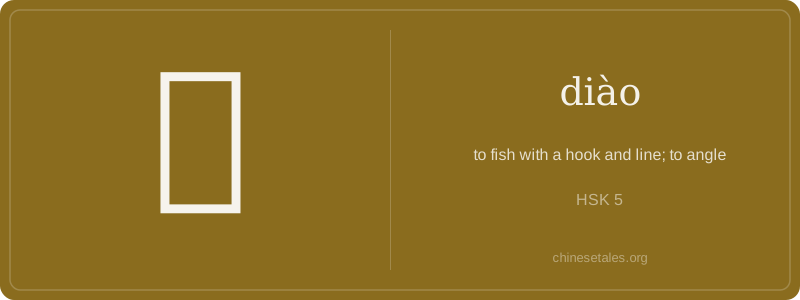
The earliest form of 钓 appears in bronze inscriptions as a pictograph combining a bent line (hook) and a hand (又), later evolving in seal script to include 钅 (metal) on the left—signifying the essential iron hook—and 召 (zhào) on the right, serving both phonetic and semantic roles: 召 means 'to summon', echoing the idea of *luring* or *drawing in*. Over centuries, the hand radical simplified, the hook merged into the top of 召, and the metal radical standardized into the left-side 钅 we see today—eight clean strokes that still whisper 'metal + call'.
This visual logic shaped its meaning: from concrete fishing practice in the Shijing (Classic of Poetry) — 'He casts his line, waits for the carp' — to philosophical extension in Zhuangzi, where 'fishing without a hook' (钓而不纲) symbolizes ethical restraint. By the Song dynasty, 钓 had acquired metaphorical weight: 钓誉 (diào yù, 'fishing for reputation') criticized scholars who performed virtue for fame. Even today, the character’s shape quietly insists: true influence isn’t seized—it’s summoned, patiently, with the right tool.
At its heart, 钓 (diào) isn’t just about dropping a line into water—it’s about *intentional patience*, the quiet art of drawing something out through subtle, sustained effort. In Chinese, it carries a gentle but unmistakable sense of agency: you’re not passively waiting; you’re actively engaging with possibility. That’s why it appears in metaphors like 钓鱼执法 (diào yú zhí fǎ)—'fishing-law-enforcement', where authorities set traps to 'catch' violations—a vivid cultural critique that reveals how deeply the verb’s core idea of deliberate enticement permeates social discourse.
Grammatically, 钓 is a transitive verb requiring an object (e.g., 钓鱼, 钓虾), and it rarely stands alone. Learners often mistakenly use it intransitively ('I go fish')—but in Mandarin, you’d say 我去钓鱼 (wǒ qù diào yú), literally 'I go [to] fish-with-hook-and-line'. Note the crucial noun-object pairing: 钓 *always* implies hook-and-line technique, never netting, spearing, or fly-fishing without a hook. Using it for those methods sounds comically inaccurate—like saying 'I’m hooking butterflies'.
Culturally, 钓 evokes literati ideals: Tang poets like Liu Zongyuan wrote of solitary angling as spiritual discipline (‘lonely fisherman on cold river’), and today, urbanites post serene WeChat stories of weekend 钓鱼—not just for catch, but for mindfulness. A common error? Confusing it with 拾 (shí, 'to pick up') or 打 (dǎ, 'to hit')—but 钓 is precise, quiet, and metallurgically rooted: its 钅 radical reminds us this craft depends on forged steel, not chance.