锁
Character Story & Explanation
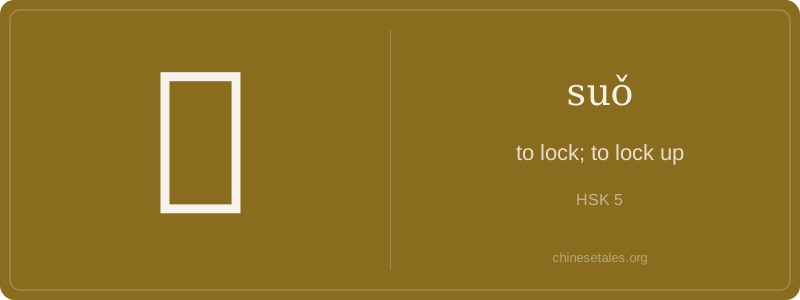
The earliest form of 锁 appears in bronze inscriptions from the Warring States period (475–221 BCE), not as a detailed keyhole, but as a stylized metal bolt sliding horizontally across two vertical posts — imagine a heavy iron bar clamped between upright pillars. The left side 钅 (metal radical) was added later to emphasize its material nature, while the right side 琐 evolved from a phonetic component 琐 (suǒ), originally depicting tangled threads — hinting at entanglement, obstruction, and secure fastening. Over centuries, the intricate knot-like top simplified into 琐’s modern 3-stroke roof (宀) + ‘small’ (小), while the lower part stabilized into 克 (kè), which here serves purely phonetically — though ironically, 克 means ‘to overcome’, reinforcing the idea of mastering access.
By the Han dynasty, 锁 appeared in texts like the Shuōwén Jiězì as ‘a device to prevent unauthorized entry’, already carrying metaphorical weight: in the Book of Rites, officials were said to ‘lock the gates of speech’ (锁言) to maintain decorum. Its visual logic is elegant: metal (钅) + phonetic ‘suǒ’ (琐) suggests something metallic that *sounds like* ‘suǒ’ and *functions like* a barrier — a rare case where sound, material, and function align seamlessly. Even today, its 12 strokes feel purposefully dense — no wasted lines, just structural certainty.
Think of 锁 (suǒ) as Chinese’s version of a Swiss Army knife for control — it doesn’t just 'lock' doors; it locks emotions, data, attention, and even time. Unlike English ‘lock’, which is mostly physical (a padlock, a car door), 锁 is delightfully elastic: you can 锁住 someone’s gaze (lock their eyes), 锁定目标 (lock onto a target), or 锁死价格 (lock in a price). It carries an almost visceral sense of restriction or finality — not passive, but deliberate, often urgent.
Grammatically, 锁 is most commonly used as a transitive verb with the resultative complement 住 (e.g., 锁住), emphasizing successful containment. You’ll rarely see it alone — it craves an object and a consequence. Learners often mistakenly use it like English ‘lock’ transitively without 住 (e.g., *他锁门 — incomplete), when native speakers say 他把门锁上了 (He locked the door shut) or 他锁住了门 (He secured the door). Also, note: 锁 is nearly always intentional — you don’t ‘accidentally lock’ something; that’s more 坏了 (broke) or 卡住 (jammed).
Culturally, 锁 evokes both security and suffocation — a duality visible in idioms like 锁心 (lock-the-heart = emotionally closed off) or in tech contexts where 锁屏 (suǒ píng, lock screen) is as routine as breathing. A common blunder? Confusing it with similar-looking characters like 琐 (trivial) — one wrong stroke turns ‘security’ into ‘nitpicking’. Remember: 锁 isn’t just about metal — it’s about intention made irreversible.