鞭
Character Story & Explanation
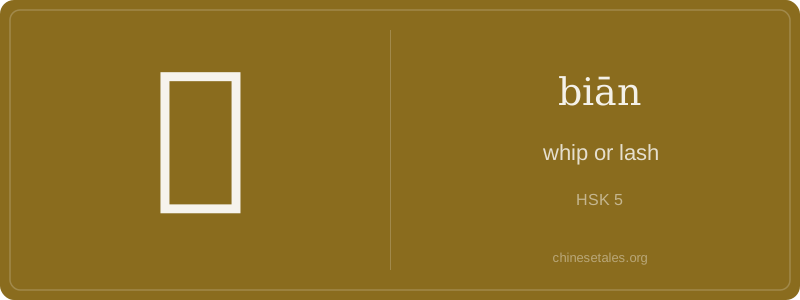
The earliest form of 鞭 appears in bronze inscriptions as a vivid pictograph: a coiled, knotted leather thong (革) with a distinct handle and braided lash — sometimes even showing three strands! Over centuries, the knotting simplified into stylized strokes, while the leather radical 革 stabilized at the left. The right side evolved from a phonetic sign representing ‘convenient action’ (便), merging with the idea of ‘applying force at the right moment’. By the Han dynasty, the character had settled into its current structure — 18 strokes, balanced, tense, ready to move.
This visual tension mirrors its semantic journey: from literal cavalry tool (mentioned in the *Zuo Zhuan* as ‘the general’s whip, guiding ten thousand horses’) to moral metaphor. In Zhuangzi, ‘whipping the mind’ (鞭心) meant sharpening awareness — not punishing thought. Even today, 鞭策 evokes self-driven rigor, not coercion. Its shape — rigid left, fluid right — perfectly captures that duality: structure enabling motion, discipline enabling freedom.
At its core, 鞭 (biān) isn’t just ‘whip’ — it’s a *flexible, controlled instrument of direction and correction*, deeply tied to authority, discipline, and motion. The radical 革 (gé, ‘leather’) tells you instantly this is made from cured hide — no plastic or metal here. The right side, 便 (biàn), isn’t just phonetic; its components (亻+更) subtly echo ‘a person applying change’ — reinforcing how a whip isn’t for brute force, but precise, timely influence. That’s why 鞭 appears in verbs like 鞭策 (biān cè, ‘to spur on’) — not ‘hit’, but ‘energize with purpose’.
Grammatically, 鞭 functions as both noun and verb. As a noun: ‘a leather whip’ (e.g., 鞭子, biān zi). As a verb: ‘to urge’ (e.g., 他鞭策自己学习——tā biān cè zì jǐ xué xí). Crucially, it’s almost never used literally for physical punishment in modern Mandarin — that’s more 拍 (pāi) or 打 (dǎ). Learners often overtranslate ‘whip’ into violent contexts, missing its elegant, metaphorical weight in academic or managerial settings.
Culturally, 鞭 carries echoes of imperial horsemen, Confucian self-cultivation (‘whipping’ one’s own laziness), and even martial arts discipline. A common mistake? Confusing it with 编 (biān, ‘to compile’) — same pinyin, totally different world. Also, don’t write the 便 part with a ‘⺅’ (knife) — it’s clearly 亻+更. The stroke count (18) is your friend: think ‘18 strokes = 18 layers of disciplined intent’.