医
Character Story & Explanation
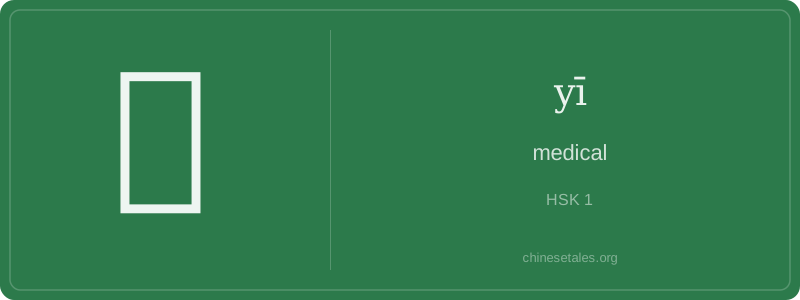
The earliest form of 医 appears on Warring States bamboo slips (c. 475–221 BCE) as a compound: a box-like shape (匚) containing a 'wood' radical (木) — representing a medicine chest holding medicinal herbs. Over centuries, the 'wood' evolved into the modern 矢 (shǐ, 'arrow'), likely due to scribal simplification and sound association (both 医 and 矢 were pronounced with a similar *-i* ending in Old Chinese). By the Han dynasty, the character stabilized into its current 7-stroke form: 匸 (the open container) + 矢 (the 'arrow' that now looks like a stylized herb bundle or healing tool).
This visual evolution reflects a deep conceptual shift: from storing physical remedies to embodying the *act* of healing itself. In the Shuōwén Jiězì (121 CE), Xu Shen defined 医 as 'the art of curing disease using medicines and techniques' — already abstracted from the chest to the practice. Interestingly, the 'arrow' component isn’t about injury; scholars believe it symbolizes precision, direction, and focused intent — like an arrow hitting the vital point of imbalance. Even today, when a TCM practitioner selects herbs, they’re still aiming that ancient 'arrow' at harmony.
Think of 医 (yī) as Chinese medicine’s 'logo' — not just 'medical' but the entire ecosystem of healing: doctors, clinics, prescriptions, and care. Unlike English where 'medical' is mostly an adjective ('medical school'), in Chinese 医 functions as a noun root and verb prefix: it’s the beating heart inside words like 医生 (doctor), 医院 (hospital), and even the verb 医治 (to treat). It rarely stands alone — you won’t say *'这个很医'* — but it’s everywhere once you know where to look.
Grammatically, 医 almost always appears in compounds or with measure words and verbs. At HSK 1, learners meet it in contexts like 'I go to the doctor' (我去医院 — wǒ qù yīyuàn), where 医 is inseparable from 院. You’ll never see 医 used adjectivally without a suffix — no 'yī shì' for 'medical staff'; instead, it’s 医务人员 (yīwù rényuán). A classic mistake? Trying to use 医 as a standalone verb like 'I yī him' — but that’s not how it works! The real verb is 治 (zhì, 'to cure'); 医 is the identity, not the action.
Culturally, 医 carries quiet reverence — it’s tied to the ancient ideal of the 'scholar-physician', someone who heals body and mind. In classical texts like the Huangdi Neijing, 医 wasn’t just technique but moral cultivation. Modern learners often mispronounce it as 'yǐ' (third tone) due to tone-sandhi confusion — but it’s always first tone: yī. And don’t mix it up with 易 (yì, 'easy') — one stroke changes everything from healing to hassle.