项
Character Story & Explanation
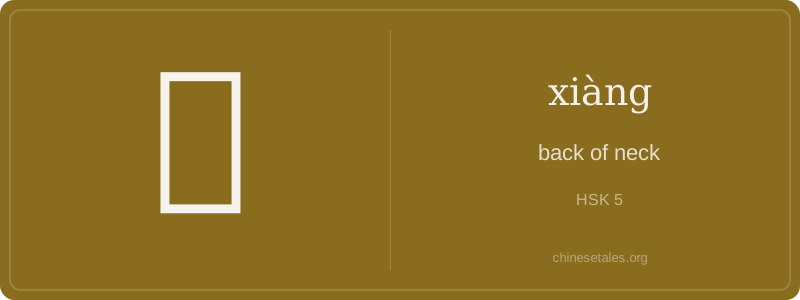
The earliest form of 项 appears in bronze inscriptions as a stylized head with a prominent vertical stroke descending from the back of the skull — clearly depicting the nape. The left side was originally 工 (gōng), representing a sturdy, upright support (like a pillar or staff), while the right side was 页 (yè), meaning ‘head’ or ‘face’. Over time, 工 evolved into 工 + 一 (a horizontal line reinforcing the ‘support’ idea), and the whole character settled into its modern nine-stroke shape: a strong vertical backbone (the first stroke) anchoring the head (页), with three short strokes beneath evoking the muscular ridge of the neck itself.
This anatomical origin deeply shaped its literary life: in the Records of the Grand Historian, Xiang Yu’s legendary defiance includes ‘taking off his 项’ — not literally decapitating himself, but offering his neck in ultimate surrender or challenge. Later, during the Song dynasty, as bureaucratic documentation exploded, 项 was extended metonymically: if your neck is what you present when stepping forward, then each ‘presented point’ in a list became an 项. Even today, seeing 项 in a government notice feels like being called to stand tall — and be counted.
At its core, 项 (xiàng) isn’t just ‘back of the neck’ — it’s a quietly powerful metaphor for prominence, exposure, and even vulnerability. In ancient China, the nape was the most visible, undefended part of the body when bowing or kneeling; thus, 项 came to symbolize *what stands out*, *what is presented*, or *what is at stake*. That’s why it’s the default character for ‘item’ or ‘entry’ in lists, budgets, or legal documents: each 项 is a distinct, countable point you can’t ignore — like a neck sticking up above the crowd.
Grammatically, 项 is a measure word-like noun that almost always appears after a number or classifier (e.g., 一 项, 三 项), never alone. You’ll rarely say ‘I did an item’ — instead, you say ‘I completed one 项 of the project’ (完成了一项任务). Learners often mistakenly treat it as a generic synonym for ‘thing’ (东西), but 项 implies structure, formality, and deliberation — it belongs in contracts, research proposals, and exam instructions, not casual chat.
Culturally, 项 reveals how Chinese conceptualizes abstraction through the body: concrete anatomy becomes bureaucratic precision. A common error is mispronouncing it as xiāng (like 相) — but xiàng carries the gravity of ‘neck’ and ‘item’, not ‘mutual’ or ‘appearance’. Also, while 页 (its radical) means ‘page’, 项 isn’t about books — it’s about what’s *presented on* the page: each listed 项 is a neck poking up from the textual surface, demanding attention.