领
Character Story & Explanation
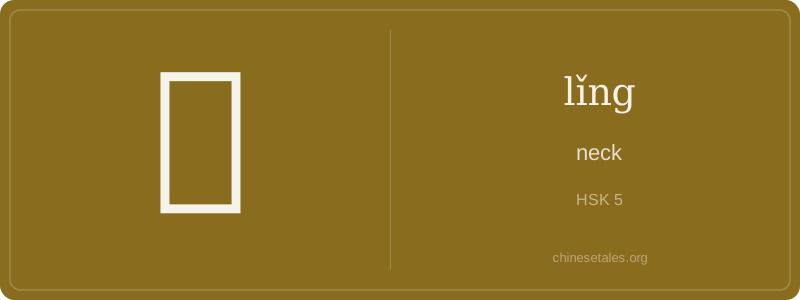
The earliest known form of 领 appears in bronze inscriptions around 1000 BCE: a head (the precursor to 页) with two parallel horizontal lines below — representing the collarbones or the top edge of a robe framing the neck. Over centuries, the head evolved into the stylized 页 radical (which itself came from a pictograph of a face with big eyes and forehead), while the lower part transformed from those collar-lines into 令 (lìng), a phonetic component meaning ‘command’ — not because the neck commands, but because 领 and 令 shared similar pronunciation in Old Chinese. The 11 strokes crystallized during the Han dynasty: first the 页 radical (6 strokes), then the 令 component (5 strokes) beneath.
This visual fusion — head + command — seeded its semantic expansion. By the Warring States period, 领 was already used in texts like the *Zuo Zhuan* to mean ‘to take charge of’, linking physical prominence (neck/head) with leadership. In classical poetry, 领 could even mean ‘to wear’ (as in wearing authority), and by the Tang dynasty, 领略 (lǐnglüè, ‘to appreciate deeply’) emerged — suggesting that true perception begins where head meets world: at the neck.
At its heart, 领 (lǐng) is all about the neck — not just the anatomical bridge between head and body, but the *pivot point* where authority, direction, and identity converge. Its radical 页 (yè, 'page' or 'leaf') originally depicted a human head in ancient scripts — and indeed, 领’s earliest forms show a head with a prominent collar or garment edge framing the neck. That visual anchor stuck: even today, when you say 领子 (lǐng·zi), you’re literally naming the ‘neck-part’ of a shirt — the collar.
Grammatically, 领 is rarely used alone as ‘neck’ in modern speech (we usually say 脖子 for casual ‘neck’); instead, it shines in compounds and abstract extensions: 领导 (lǐngdǎo, ‘to lead’) implies guiding *from the front*, like a head leading the body; 领取 (lǐngqǔ, ‘to collect/receive’) evokes ‘taking hold at the neck’ — grasping something offered directly, ceremonially, or officially. Learners often mistakenly use 领 for ‘neck’ in everyday contexts (e.g., ‘my neck hurts’) — but that’s 脖子 territory. Reserve 领 for formal, directional, or institutional meanings.
Culturally, 领 carries quiet hierarchy: 领带 (lǐngdài, ‘tie’) isn’t just fabric — it’s a sartorial leash of professionalism; 领域 (lǐngyù, ‘domain/field’) marks intellectual or territorial jurisdiction — as if one’s ‘neck’ defines the boundary of their sphere of influence. Even the verb 领会 (lǐnghuì, ‘to comprehend’) suggests ‘grasping with the head/neck’ — a full-body metaphor for deep understanding.