骤
Character Story & Explanation
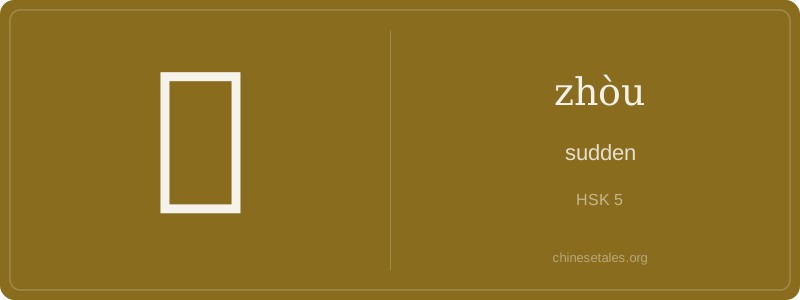
The earliest form of 骤 appears in bronze inscriptions as a combination of 马 (mǎ, horse) and 叔 (shū, later simplified to 又 + 豕), but crucially, the top component evolved from a pictograph of *two horses galloping in tandem*, their hooves striking the ground in rapid, synchronized succession — visual onomatopoeia for explosive motion. Over time, the double-horse motif condensed into the top-left 隹-like shape (actually a stylized ‘crow’ radical in some variants, but here a phonetic remnant of *zhòu*), while the 马 radical stayed firmly at the bottom, anchoring the meaning in animal-driven urgency.
By the Han dynasty, 骤 had solidified as a literary term for ‘sudden, violent movement’ — especially of natural forces. In the Book of Songs (Shījīng), it describes ‘horses surging forward without warning’; by the Tang, poets like Du Fu used 骤雨 (zhòu yǔ) to evoke summer storms that drown rooftops in seconds. The horse radical isn’t decorative — it’s the engine: every sudden event in Chinese cosmology implied kinetic energy, and nothing embodied that better than a galloping horse breaking stride mid-run. Even today, seeing 骤 triggers subconscious imagery of motion arrested and restarted in a heartbeat.
Think of 骤 (zhòu) as the Chinese equivalent of a sudden thunderclap in a quiet library — not just 'sudden', but *violently abrupt*, carrying visceral momentum and a sense of unstoppable force. Unlike English ‘sudden’, which is neutral, 骤 implies a sharp break in continuity: weather shifts, emotions flare, or situations collapse *in an instant*. It’s rarely used alone — you’ll almost always see it in compounds like 骤然 (zhòu rán) or 骤雨 (zhòu yǔ), or as part of the adverbial pattern 骤 + verb (e.g., 骤降 — 'plummet suddenly').
Grammatically, 骤 functions almost exclusively as an adverbial modifier before verbs or adjectives — never as a standalone adjective before nouns (*not* 'a 骤 change'). Learners often mistakenly say *zhòu biàn* ('sudden change') when they mean 突然的改变 (tūrán de gǎibiàn); 骤 must be paired with another word (usually 然, 降, 升, 停, etc.) to form a functioning unit. Its tone (zhòu, fourth tone) is sharp and falling — like the snap of a whip — reinforcing its semantic punch.
Culturally, 骤 echoes classical Chinese’s love for economy and intensity: one character conveys what English needs two or three words to express. It appears frequently in literary descriptions of nature (sudden downpours, abrupt wind shifts) and political commentary (e.g., 骤变 — 'abrupt transformation' — often implying instability). A common mistake? Confusing it with 骤 vs. 突 — but while 突 emphasizes unexpectedness, 骤 stresses *speed + force + discontinuity*. Think: a lightning strike (骤) versus spotting a stranger in your hallway (突).