鬼
Character Story & Explanation
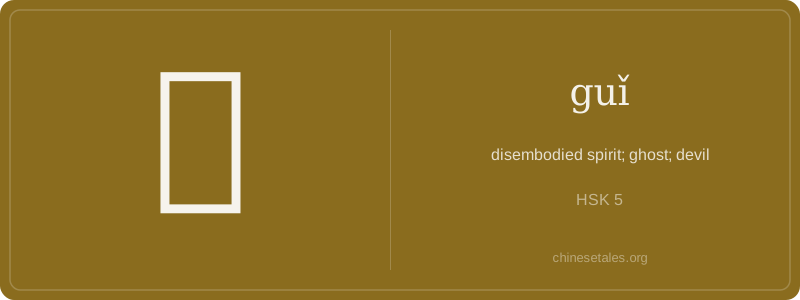
The earliest form of 鬼 appears in oracle bone inscriptions (c. 1200 BCE) as a striking pictograph: a kneeling figure with an exaggerated, grotesque head — large eyes, a wide mouth, and wild hair — representing a spirit seen in trance or ritual vision. Over centuries, the ‘person’ component (the kneeling posture) simplified into the left-side radical 鬼 itself, while the top evolved from a stylized head into the modern ‘white’-like shape (丿一厶), and the lower strokes hardened into the ‘foot-like’ 乛 and final dot — preserving the original sense of a being that walks among us, yet doesn’t belong.
This visual strangeness reflects ancient Shang dynasty beliefs: spirits weren’t distant gods but immediate, tangible presences — sometimes helpful, often demanding. In the Zuo Zhuan, Confucius famously says, ‘敬鬼神而远之’ (jìng guǐshén ér yuǎn zhī) — ‘Revere spirits and gods, yet keep them at a distance’ — capturing the pragmatic reverence embedded in the character. Its shape never softened because its function was never to comfort: 鬼 reminds you that the boundary between life and what follows is thin, visible, and deeply human — not divine.
At its core, 鬼 isn’t just ‘ghost’ — it’s the uncanny residue of human presence after death: ambiguous, emotionally charged, and culturally porous. Unlike Western ‘ghosts’ that haunt for vengeance or closure, Chinese 鬼 often embody unresolved social ties — a filial duty unfulfilled, a vow broken, or ancestral energy drifting without proper rites. This makes 鬼 deeply relational, not supernatural in a vacuum.
Grammatically, 鬼 is surprisingly versatile: it can be a noun (yī gè guǐ — ‘a ghost’), but also functions as a colloquial intensifier meaning ‘extremely’ or ‘crazy’, especially in spoken Mandarin — like 鬼大 (guǐ dà, ‘huge — ridiculously so’) or 鬼聪明 (guǐ cōngmíng, ‘devilishly smart’). Learners often miss this slang use and translate literally, missing the speaker’s playful irony. Also note: it rarely appears alone in formal writing; instead, it’s almost always in compounds (e.g., 魔鬼, 小鬼) or idioms.
Culturally, calling someone 小鬼 (xiǎo guǐ) to a child isn’t insulting — it’s affectionate teasing, like ‘little rascal’. But calling an adult 鬼 without context? That’s either cheeky familiarity or outright rudeness. A classic learner trap: overusing 鬼 to mean ‘evil spirit’ when 魔 (mó) or 妖 (yāo) fit better for malevolent, non-ancestral entities. And crucially: 鬼 ≠ ‘demon’ in the Christian sense — there’s no moral binary here. A 鬼 is first and foremost *unquiet*, not necessarily evil.