龙
Character Story & Explanation
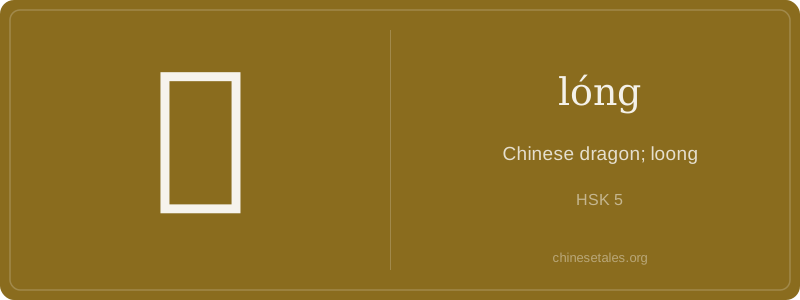
The earliest form of 龙 appears in oracle bone inscriptions (c. 1200 BCE) as a vivid, sinuous creature with antlers, bulging eyes, a long body, and clawed feet — unmistakably serpentine yet majestic. Over centuries, bronze script simplified its coils; seal script stylized its head and mane; clerical script flattened its curves; and by regular script, the modern five-stroke 龙 emerged: the top dot (丶) as a horn or flame, the curved stroke (㇇) as a sweeping antler or crest, the vertical (丨) as a noble spine, and the two final strokes (丿 and 乚) as coiling tail and claw — all distilled into elegant minimalism.
This visual distillation mirrors its conceptual evolution: from Shang dynasty rain deity to Zhou dynasty symbol of royal virtue, then Han dynasty embodiment of cosmic qi, and finally Tang–Song literary motif of transcendence. In the Classic of Poetry, dragons pull celestial chariots; in Journey to the West, the Dragon Kings rule oceans — not as villains, but as dutiful bureaucrats of nature. The character’s streamlined shape reflects millennia of reverence: less about literal depiction, more about capturing *presence*, *power*, and *flow* in five decisive strokes.
Forget Western dragons — 龙 (lóng) is a celestial, benevolent force: wise, auspicious, and deeply tied to water, rain, and imperial authority. It’s not a monster to slay but a symbol of power *in harmony* — think of the Dragon Boat Festival or the emperor’s ‘dragon robe’. The character itself feels regal and flowing, almost like a coiled serpent rising through mist.
Grammatically, 龙 is mostly a noun, but it shines in compounds and metaphors. You won’t say ‘a dragon’ with a measure word like 一只龙 (that’s unnatural); instead, you’ll use it in set phrases: 望子成龙 (wàng zǐ chéng lóng — ‘hope your child becomes a dragon’, i.e., excels), or as part of names like 龙门 (Lóngmén, ‘Dragon Gate’). It rarely stands alone in speech — unlike English ‘dragon’, it’s rarely used bare without cultural framing.
Culturally, calling someone a ‘dragon’ is high praise — but calling them a ‘Western dragon’ (like 恶龙 è lóng) flips the meaning entirely! Learners often misapply 龙 in translations, forcing English dragon imagery onto Chinese contexts. Remember: no fire-breathing, no hoarding gold — this dragon controls clouds, brings harvests, and embodies yang energy. Also, note that 龙 is its own radical — rare and powerful, like the creature itself.