乞
Character Story & Explanation
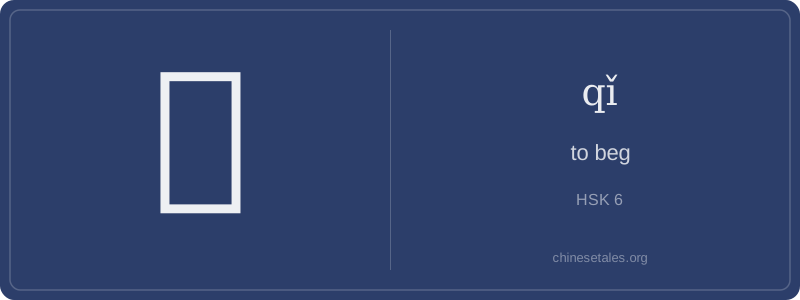
The earliest form of 乞 appears on Shang dynasty oracle bones as a simplified variant of 气 (qì, ‘breath’ or ‘vital energy’): three horizontal strokes representing exhalation—soft, continuous, almost pleading breaths. Over time, scribes rotated the top stroke downward, merging it with the middle stroke to create the distinctive hook of the modern 乙 radical at the top, while retaining the two lower strokes as a minimalist gesture of hands clasped together—like someone bowing low, palms up, breath shallow, posture yielding. By the Han dynasty, this elegant reduction was standardized: three clean strokes—no frills, no flourish—just humility distilled into ink.
This visual economy mirrors its semantic evolution: from ‘exhaling’ (a neutral physiological act) to ‘pleading breath’ (a vocalized appeal), then solidifying as ‘to beg’ by the Warring States period. In the Book of Rites, 乞 appears in rituals where petitioners 乞福 (qǐ fú, ‘beg for blessings’) before ancestral tablets—never shouting, always kneeling, voice hushed like held breath. The character’s stark simplicity—just three strokes—mirrors how Chinese tradition values restraint in supplication: true humility needs no embellishment, only sincerity in the curve of a wrist and the pause before speech.
Think of 乞 (qǐ) as Chinese’s linguistic equivalent of holding up a cardboard sign at a crosswalk—not with desperation, but with quiet, almost ritualized humility. It doesn’t just mean ‘to beg’; it carries the weight of *asking for something you lack—gracefully, persistently, and often in contexts where power imbalance is baked into the grammar*. Unlike English ‘beg’, which can be colloquial or even ironic (‘I beg to differ’), 乞 is formal, literary, and slightly archaic in everyday speech—yet indispensable in classical allusions, bureaucratic language, and high-register writing.
Grammatically, 乞 functions primarily as a transitive verb, almost always followed by what’s being requested: 乞援 (qǐ yuán, ‘to beg for aid’), 乞假 (qǐ jià, ‘to request leave’). Crucially, it rarely appears alone—it needs an object, like a polite but insistent hand extended toward a specific thing. Learners often mistakenly use it where 求 (qiú) or 申请 (shēnqǐng) would be more natural; 乞 implies vulnerability, not entitlement. You’d 乞命 (qǐ mìng, ‘beg for one’s life’) in a Ming dynasty novel—but file a 申请 for a visa today.
Culturally, 乞 evokes the Confucian tension between dignity and necessity: begging isn’t shameful if done with proper humility and restraint. That’s why it appears in idioms like 乞哀告怜 (qǐ āi gào lián)—‘to plead pitifully’, used ironically to criticize excessive self-abasement. A common mistake? Using 乞 in casual speech (e.g., ‘Can I beg a coffee?’); native speakers would say 我能要杯咖啡吗?—not *我乞一杯咖啡*.