予
Character Story & Explanation
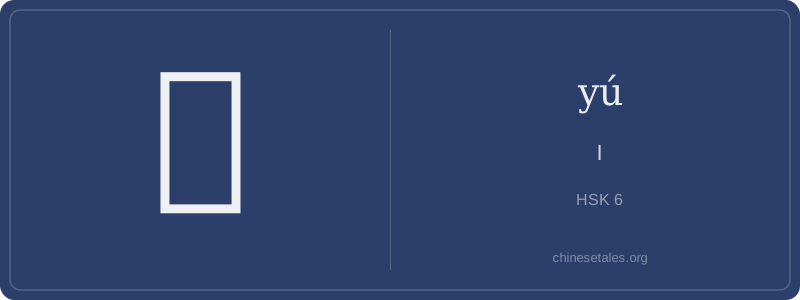
The earliest form of 予 appears on Shang dynasty oracle bones as a pictograph resembling a hand holding a sharp tool — likely a ceremonial knife or awl — extended outward. Scholars believe it originally depicted the act of *giving* or *bestowing*, with the hand (-like component) and blade (the downward stroke) combined. Over time, the tool simplified into a single vertical hook (亅), while the hand evolved into the upper horizontal and diagonal strokes — compressing gesture into abstraction. By the Warring States period, the seal script had stabilized into the four-stroke shape we recognize: a short horizontal top, a descending diagonal left, a longer diagonal right, and the decisive downward hook — a visual 'I' reaching out, not inward.
This outward gesture became metaphorically inverted: the one who gives must first *be present* — hence the shift from 'to bestow' to 'I, the giver'. In the *Mencius*, 予 appears repeatedly in philosophical self-reference ('予岂好辩哉?' — 'Do I delight in debate?'), anchoring moral agency in the speaker. The hook (亅) — now the radical — isn’t passive; it’s the pivot point where intention meets action. Even today, the stroke order demands you *begin* with the horizontal (intention), *move* diagonally (engagement), then *anchor* with the hook (self-assertion). It’s not 'me' — it’s 'I, stepping forward to offer.'
At first glance, 予 (yú) looks disarmingly simple — just four strokes — but don’t be fooled: it’s a literary fossil carrying the weight of classical Chinese identity. Unlike the colloquial 我 (wǒ), 予 is strictly formal, archaic, or poetic — think Shakespearean 'I' versus modern 'I'. It appears almost exclusively in written contexts: classical allusions, solemn speeches, legal documents, or self-introductions in academic papers ('予谨此申明…'). You’ll never hear it in daily conversation — saying 'yú ài nǐ' to your partner will earn you a puzzled blink and possibly an invitation to recite the Analects.
Grammatically, 予 behaves like a subject pronoun but with rigid register constraints. It can’t be pluralized (no *予们), doesn’t take aspect particles like 了 or 过, and rarely appears with colloquial modals. Crucially, it’s often paired with classical verb forms: 予以为 (yú yǐwéi, 'I hold that...'), 予将 (yú jiāng, 'I shall...'), or 予尝 (yú cháng, 'I once...'). A common mistake? Using it in spoken Mandarin — or worse, confusing it with the homophone 与 (yǔ, 'and/with'), which shares the same radical but zero semantic overlap.
Culturally, 予 carries quiet authority and humility in one stroke: in classical texts, it signals the speaker’s conscious alignment with scholarly tradition — not arrogance, but disciplined self-positioning. Learners often overuse it trying to sound 'more Chinese', but native readers instantly spot inauthenticity. The real magic? Its rarity makes it powerful: when a judge writes 予判 in a verdict, or a poet opens with 予独爱莲之出淤泥而不染, that single character anchors the entire voice in centuries of textual gravity.