仰
Character Story & Explanation
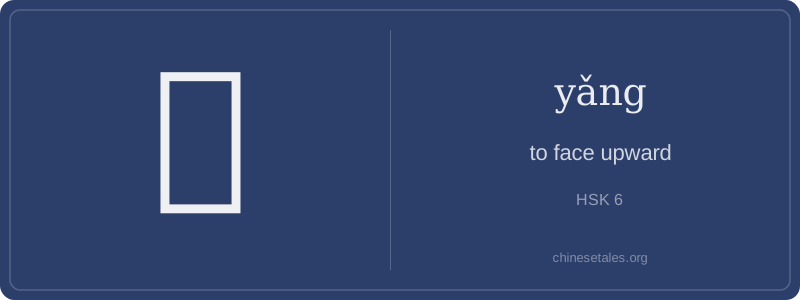
The earliest form of 仰 appears in bronze inscriptions as a person (亻) beside a stylized head with an exaggerated upward tilt — sometimes with a line indicating the direction of gaze. Over time, the head evolved into 昂 (áng), a character meaning ‘to raise high’ or ‘to lift one’s head proudly.’ By the seal script era, the left side solidified as the 人 (rén) radical, simplified to 亻, while the right became 昂 — merging person + elevation. The six strokes today — two for the radical (撇 + 竖), four for 昂 (竖 + 横折 + 横 + 撇) — encode this ancient visual idea: a human deliberately raising their face skyward.
This upward gesture carried profound resonance in early texts: in the Classic of Poetry, characters 仰瞻 (yǎngzhān) describe gazing at ancestral altars; in Mencius, 仰不愧于天 (yǎng bù kuì yú tiān) — ‘looking up, I feel no shame before Heaven’ — ties physical posture to moral integrity. The character didn’t just describe anatomy; it mapped conscience onto the body. Even today, when someone says 我仰慕您 (wǒ yǎngmù nín), they’re not just ‘admiring’ you — they’re symbolically lifting their gaze *and* their moral compass toward you.
At its heart, 仰 isn’t just ‘to face upward’ — it’s a verb charged with reverence, aspiration, and physical posture all at once. In Chinese, looking up isn’t neutral: it implies respect (仰慕 yǎngmù — to admire deeply), yearning (仰望 yǎngwàng — to gaze up at, often metaphorically at ideals or heroes), or even vulnerability (仰卧 yǎngwò — lying supine, exposing the chest). Unlike English, where ‘look up’ is mostly directional, 仰 carries emotional gravity — you don’t 仰 a ceiling; you 仰 a mentor, a mountain, or destiny.
Grammatically, 仰 is almost always transitive and appears in compound verbs or set phrases — rarely standalone. Learners mistakenly try to use it like ‘raise your head’ (e.g., *‘tā yǎng tóu’ — which sounds unnatural without context), but native speakers say 仰起头 (yǎng qǐ tóu) or embed it in compounds like 仰视 (yǎngshì, ‘to look up at’). It also appears in formal written registers more than speech — you’ll see it in essays on Confucian ethics or political speeches about ‘looking up to the Party’s guidance,’ not casual chat.
Culturally, 仰 reveals how Chinese thought links bodily orientation with moral stance: bowing down shows humility; looking up shows aspiration — but also submission or awe. A common error? Confusing it with 抑 (yì, ‘to suppress’) or 忘 (wàng, ‘to forget’) due to similar stroke endings — but 仰’s radical 亻 (person) + 昂 (to raise high) makes its core meaning unmistakably *human posture toward something greater*. That duality — physical gesture + inner attitude — is pure classical Chinese philosophy in one character.