伏
Character Story & Explanation
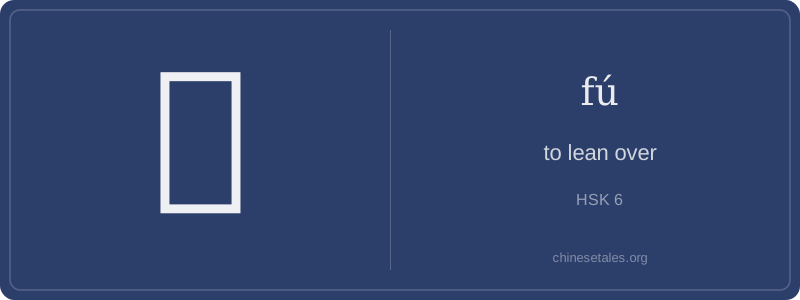
The earliest form of 伏 appears in bronze inscriptions as a person (亻) beside a bent arm or curved line representing a lowered body — sometimes even with a head tilted downward. Over centuries, the right side evolved from a pictograph of a kneeling figure with arms folded (甲骨文) into the component , which later fused with the 'flesh' radical 肉, emphasizing the bodily, grounded nature of the action. By the seal script era, the structure stabilized: the left 亻 clearly signals 'person', while the right side, though now abstracted, preserves the visual echo of a torso bending forward — a compact, elegant compression of motion into six strokes.
This bending motif carried deep semantic resonance. In the Classic of Poetry (Shījīng), 伏 appears in lines describing subjects bowing before rulers — not just physically, but morally. By the Warring States period, strategists like Sun Tzu used 伏 in military treatises for 'concealed deployment', linking posture to power. Even today, the character’s shape — a person leaning forward — visually echoes its dual meanings: submission and stealth. That same curve appears in 伏羲 (Fúxī), the mythic sage who 'bent over' (figuratively) to observe patterns in nature and invent writing — making 伏 not just a posture, but the first gesture of human insight.
At its heart, 伏 (fú) is about *controlled lowering* — not collapse, not surrender, but a deliberate, often strategic, bending or crouching. Think of a cat coiled low before pouncing, or a scholar bowing deeply in reverence: it’s posture with purpose. The radical 亻 (person) anchors it in human action, while the right side (a simplified form of 肉, 'flesh') hints at bodily submission — not weakness, but focused physical presence. This isn’t passive; it’s active humility, concealed readiness, or respectful deference.
Grammatically, 伏 shines in formal and literary contexts. As a verb, it appears in set phrases like 伏案 (fú àn, 'to lean over a desk' — studying intently) or 伏击 (fú jī, 'ambush' — lying in wait). It rarely stands alone in modern speech; you’ll almost never say 'I 伏' casually. Instead, it’s embedded in compounds or classical-style constructions — like 伏首 (fú shǒu, 'to bow one’s head in submission') or the idiom 降龙伏虎 (jiàng lóng fú hǔ, 'to subdue dragons and tigers', meaning to master formidable challenges). Learners often misapply it as a simple synonym for 'lie down' (which is 躺 tǎng) — a mistake that turns 'He lay on the grass' into 'He submitted himself to the grass!'
Culturally, 伏 carries weight from Confucian ritual and military strategy alike. In classical texts, 伏罪 (fú zuì) means 'to confess guilt by kneeling' — a physical act of moral acknowledgment. And don’t miss the seasonal term 三伏 (sān fú), the 'three dog days' of summer — named because ancient people believed yang energy was 'lying low' (伏) under extreme heat, hiding until autumn. That subtle, almost metaphysical layer — where posture mirrors cosmic rhythm — is what makes 伏 unforgettable.