佳
Character Story & Explanation
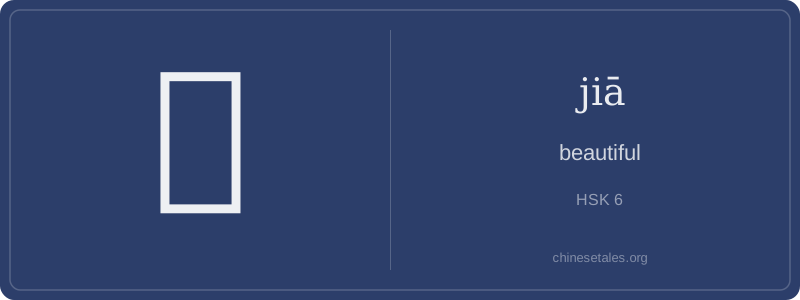
The earliest form of 佳 appears in bronze inscriptions around 1000 BCE — not as a pictograph, but as a phonosemantic compound already. Its left side 亻 (rén bàng) signals ‘human-related’, while the right side 吉 (jí, ‘auspicious’) provides both sound and meaning. Over centuries, 吉 simplified: its top 士 became 土, and its bottom 口 stayed intact — giving us today’s 佳 with its clean, balanced 8-stroke structure: two strokes for 亻, six for 吉-derived right component. The stroke order flows elegantly — first the ‘person’ radical, then the ‘auspicious’ half — mirroring how human excellence arises from favorable alignment.
This fusion wasn’t accidental: in the Shijing (Book of Odes), 佳 appears in phrases like ‘佳人’ — referring to a noble, cultivated person whose inner virtue radiates outward. By the Han dynasty, it was firmly established as the character for ‘excellent’ in a moral-aesthetic sense, distinct from mere visual appeal. Its visual symmetry (4+4 strokes per side in early seal script) echoes its semantic core: harmony between humanity and auspiciousness — making 佳 less a description than a quiet verdict of worth.
Imagine you’re at a traditional Chinese wedding banquet, and the host raises a toast: ‘Zhè yì duì xīn rén zhēn shì tiān zuò zhī hé, jiā ǒu tiān chéng!’ — ‘This couple is truly heaven-made, a perfect match!’ Here, 佳 isn’t just ‘beautiful’ like a pretty flower; it’s *excellence with harmony*, elegance with virtue — the kind of beauty that resonates morally and aesthetically. It carries quiet dignity, never flashiness. You’ll rarely hear it describing a person’s physical face alone (that’s more 漂亮 or 美); instead, it modifies abstract nouns: 佳作 (masterpiece), 佳音 (good news), 佳节 (festive season).
Grammatically, 佳 is almost always an attributive adjective — it *must* come before the noun, never after, and never stands alone as a predicate (*×tā hěn jiā*). It’s also highly literary: you’ll see it in formal writing, poetry, or ceremonial speech — not in casual chat. Learners often mistakenly use it like English ‘good’ (e.g., *jiā de qíngkuàng*), but native speakers say 好的 or 良好的 there. Also, 佳 never takes degree adverbs like 很 — it’s inherently absolute, like ‘supreme’ or ‘peerless’.
Culturally, 佳 reflects Confucian ideals: beauty isn’t skin-deep but arises from balance, propriety, and resonance with cosmic order. That’s why it appears in classical phrases like 佳人 (a virtuous, refined person — originally gender-neutral, though now often poetic for ‘lovely lady’) and 佳期 (a propitious, auspicious time — think Qixi Festival, the ‘Chinese Valentine’s Day’). Misusing it as a casual synonym for ‘good’ risks sounding archaic, pretentious, or even sarcastic — like calling your roommate’s messy apartment ‘a masterpiece’.