飞
Character Story & Explanation
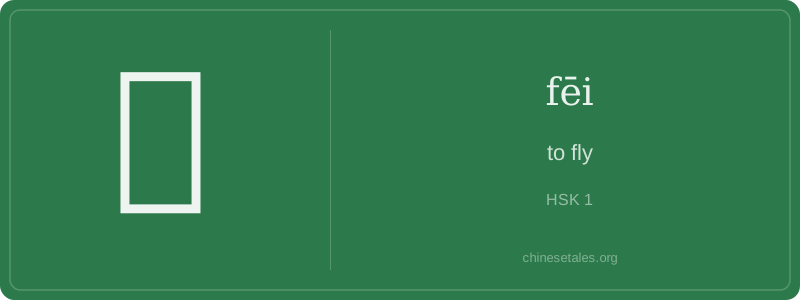
The earliest form of 飞 appears in oracle bone script (c. 1200 BCE) as a stylized bird mid-flight: two outstretched wings and a curving tail — no head, no feet, just pure motion captured in three fluid strokes. By the bronze script era, the wings became more angular, and the tail curled downward like a swoop. In seal script, the character condensed further: the top stroke became a sweeping horizontal 'wing', the middle a rising diagonal 'body in ascent', and the bottom a sharp, upward-flicking 'tail' — all three strokes designed to mimic the *trajectory* of flight, not the anatomy of a bird.
This visual logic stuck: the modern 飞 isn’t a picture of a bird, but a kinetic glyph — three strokes that *move*. Confucius’ Analects doesn’t mention 飞 much, but Zhuangzi’s Daoist parables did — famously, the giant Peng bird that 'flies from the Northern Ocean to the Southern Ocean', symbolizing liberation from earthly limits. Even today, calligraphers emphasize the upward energy of the final stroke, making it rise like a kite catching wind — proving that 3,200 years later, this character still soars.
Imagine a sparrow bursting upward from a bamboo branch — wings flaring, tail fanning, body tilting into the wind. That sudden, weightless lift? That’s 飞 (fēi) in action: not just ‘to fly’ as a static fact, but *the moment of taking off*, the energy of ascent, the freedom of motion through air. In Chinese, 飞 is almost always used as a verb — it rarely stands alone, but shines in dynamic phrases like 飞走 (fēi zǒu, 'fly away'), 飞来 (fēi lái, 'fly over/arrive by air'), or even metaphorically in 飞快 (fēi kuài, 'extremely fast' — as if speed itself had wings).
Grammatically, it behaves like most HSK 1 verbs: subject + 飞 + object/direction/complement. You’ll hear it in daily life — 'The plane flies to Beijing' (飞机飞到北京), 'Birds fly south in winter' (鸟儿冬天飞到南方), or even playfully: 'My phone battery flew away!' (我的手机电量飞走了!). Note: unlike English, you don’t say 'I fly' for habitual travel — use 坐飞机 (zuò fēijī, 'take a plane') instead. Learners often overuse 飞 literally — no one says 'I fly to work' unless they’re a pilot!
Culturally, 飞 carries poetic and aspirational weight: in classical poetry, it evokes transcendence (e.g., Li Bai’s 'I wish to ride the wind and fly'). Today, it’s in tech buzzwords like 飞行汽车 (fēixíng qìchē, 'flying car') and slang like 飞了 (fēi le) meaning 'gone missing' or 'vanished' — a lighthearted, slightly dramatic way to say something disappeared in a blink.