侧
Character Story & Explanation
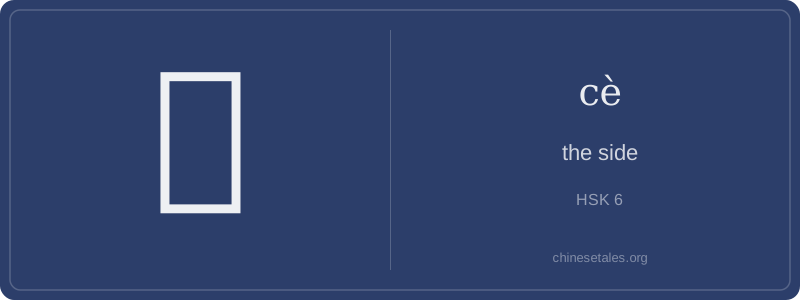
The earliest form of 侧 appears in bronze inscriptions as a combination of 人 (person) and 则 (originally a pictograph of a knife cutting a line on a turtle shell for divination—later phonetic). The person radical 亻 shows human agency, while the right-hand component 则 evolved from 刀 + 贝 (knife + shell-money), signifying 'a decisive act'—literally, 'cutting a boundary'. Over centuries, the knife simplified into the stroke-rich 则 we see today, and the whole character came to suggest 'a person taking position relative to a defined boundary'—not just physical space, but social or conceptual lines.
By the Han dynasty, 侧 acquired its core sense of 'side' and 'inclination'—appearing in phrases like 侧目 (cèmù, 'to glance sideways', implying awe or wariness) and 侧隐 (cèyǐn, now written 恻隐, 'compassion', from the idea of 'feeling from the side'—empathy as emotional positioning). Its visual duality—human figure plus boundary marker—mirrors its semantic duality: both spatial orientation and moral stance. In Tang poetry, Li Bai wrote of 侧身天地 (cèshēn tiāndì), 'sidestepping between heaven and earth', evoking humility before cosmic scale—a usage still resonant in modern essays on ecological responsibility.
Think of 侧 (cè) as the Chinese equivalent of the English word 'side'—but with the quiet authority of a diplomat at a summit. It doesn’t just mean *a* side; it implies perspective, positioning, and subtle relational nuance—like choosing which side of the table to sit at during a negotiation. In English, 'side' is neutral; in Chinese, 侧 carries gentle gravity: it’s the side you lean toward emotionally (偏向一侧), the side you observe from objectively (旁观者视角), or the side that remains unseen (另一侧). It’s rarely used alone—it needs context: 左侧 (left side), 侧面 (side view), or 侧重 (to emphasize one aspect over another).
Grammatically, 侧 shines in compound nouns and verbs. As a noun suffix (e.g., 侧面), it turns abstract ideas into tangible angles—'the flip side' literally becomes 侧面. As part of the verb 侧重 (cèzhòng), it signals deliberate prioritization ('We prioritize sustainability'), not passive preference. Learners often mistakenly use 侧 where they need 偏 (piān) for 'bias' or 旁 (páng) for 'beside'—but 侧 is about orientation and measured attention, not mere proximity or prejudice.
Culturally, 侧 reflects China’s long-standing emphasis on relational positioning—how you stand *in relation to* power, truth, or tradition. In classical texts like the *Zuo Zhuan*, 侧 is used to describe ministers standing 'to the side' of the ruler—not subserviently, but as advisors holding space for alternative views. A common error? Using 侧 instead of 旁 when meaning 'nearby' (e.g., 旁边 is 'next to', not 侧边). And yes—though zhāi is an archaic literary reading (e.g., in 侧身 'to sidestep'), cè is the only pronunciation you’ll ever need for modern speech and HSK 6.