杰
Character Story & Explanation
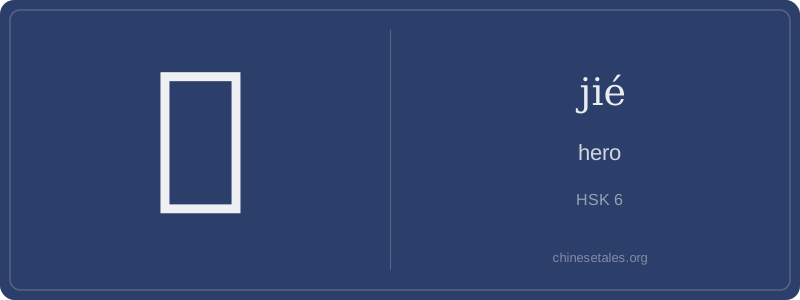
The earliest form of 杰 appears in seal script (c. 3rd century BCE), where it combined two key elements: the 木 (mù, 'tree') radical on the left — representing stability, height, and natural excellence — and a right-hand component that evolved from 可 (kě, 'can, may'), which itself originally depicted a mouth (口) under a lid-like structure, suggesting authority and capability. Over time, 可 simplified into the modern upper-right shape (一 + 亅 + 丿), while the 木 remained steadfast. Stroke by stroke, the character solidified into its current eight-stroke form: the four strokes of 木 (horizontal, vertical, dot,捺), followed by the four strokes of the right side — a horizontal, hook, diagonal, and final downward stroke — creating a balanced, upright silhouette.
This visual duality — rootedness + capability — shaped its meaning. In the *Zuo Zhuan* (c. 4th century BCE), 杰 described officials of exceptional virtue and administrative skill, 'those who stand tall among men like trees among shrubs.' By the Tang dynasty, poets like Du Fu used it to praise cultural luminaries: '文采出众者为杰' ('Those whose literary brilliance surpasses others are 杰'). The wood radical wasn’t arbitrary: just as a great tree grows straight and strong from deep roots, a true 杰 embodies cultivated excellence grounded in integrity — not sudden flash, but enduring stature.
At first glance, 杰 (jié) feels like a bold, upright character — and that’s no accident. Its core meaning isn’t just ‘hero’ in the Hollywood sense, but someone *outstanding*, *exceptional*, or *eminent*: a person who literally stands out from the crowd, often through talent, virtue, or achievement. In classical Chinese, it carried weighty moral overtones — think Confucian ‘exemplary persons’ (君子), not caped crusaders. Today, it’s used almost exclusively in formal or literary contexts: you’d call a Nobel laureate a 科学巨匠 (jùjiàng, 'master of science'), not your cousin who fixed your Wi-Fi.
Grammatically, 杰 is almost never used alone. It appears in compounds like 英杰 (yīngjié, 'heroic figure'), 俊杰 (jùnjié, 'outstanding talent'), or as part of names (e.g., Wang Jie). Learners often mistakenly treat it like an adjective — saying *‘tā hěn jié’* — but that’s ungrammatical; 杰 doesn’t function predicatively. Instead, it’s a noun or attributive noun: *tā shì yī wèi yīngjié* ('He is a hero'), not *tā hěn yīngjié*. You’ll also see it in bureaucratic terms like 杰出人才 (jiéchū réncái, 'outstanding talent') — a phrase plastered across university recruitment posters.
Culturally, 杰 evokes reverence, not casual admiration. Calling someone 杰 implies they’ve achieved something historically or socially significant — hence its rarity in speech and dominance in official discourse. A common learner trap? Confusing it with 竭 (jié, 'to exhaust') — same sound, opposite energy! Also, don’t forget the radical: 木 (wood) isn’t decorative — it hints at growth, strength, and rooted excellence, like a towering tree rising above the forest canopy.