么
Character Story & Explanation
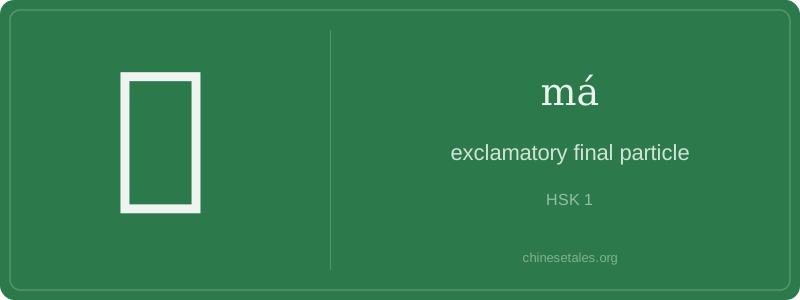
The earliest form of 么 appears in Warring States bamboo slips (475–221 BCE) as a simplified variant of 幺 (yāo), which itself evolved from an oracle bone glyph depicting a coiled thread or tiny cord — three short strokes curling inward, symbolizing ‘the smallest thing’. Over time, the curve straightened, strokes detached, and the character shrank to just three minimalist marks: a falling stroke (丿), a dot (、), and a final hook (乚) — a visual echo of something delicate, almost vanishing. By the Han dynasty, this reduced form was adopted specifically for grammatical use, shedding its original ‘tiny’ meaning to become purely functional.
Its semantic pivot is fascinating: from ‘smallest thing’ (幺) to ‘lightest grammatical particle’ (么) — a natural extension of scale into linguistic weight. In classical texts like the *Mencius*, early variants appear in rhetorical questions implying doubt or expectation, foreshadowing its modern role. The visual sparseness — just three strokes, no enclosed space, no complexity — mirrors its syntactic humility: it adds nuance without asserting authority, like a whisper that changes the entire tone of the room.
Think of 么 (má) as Chinese’s linguistic eyebrow raise — a tiny, three-stroke punctuation mark that doesn’t carry meaning on its own, but instantly transforms a statement into a gentle, curious, or mildly insistent question. It’s not the forceful ‘?’ of English, nor the blunt ‘right?’ of tag questions — it’s more like adding ‘…really?’ or ‘…isn’t it?’ at the end of a sentence, with softness and warmth baked in. You’ll hear it constantly in daily speech: ‘Hǎo má?’ (Good…? / Is it good?) isn’t demanding confirmation — it’s inviting shared understanding.
Grammatically, 么 only appears at the *end* of yes/no questions — never alone, never mid-sentence, and never after verbs like ‘to be’ (shì). Crucially, it *only follows adjectives, nouns, or stative verbs*, and *never* follows dynamic verbs like ‘eat’ or ‘go’. So ‘Nǐ chī le má?’ is wrong — but ‘Nǐ hěn gāoxìng má?’ (You’re very happy, right?) is perfect. It’s the polite pause before an answer, like handing someone a teacup with both hands.
Culturally, 么 signals relational harmony: using it shows you’re checking in, not interrogating. Learners often overuse it — inserting it after every verb — or confuse it with the neutral tone ‘ma’ (吗), which *does* follow verbs. Also, while 么 is pronounced má here, it’s reduced to me in compounds like ‘shénme’ (what) — a subtle sound shift that reflects how function words shrink under usage pressure, much like English ‘going to’ → ‘gonna’.