僵
Character Story & Explanation
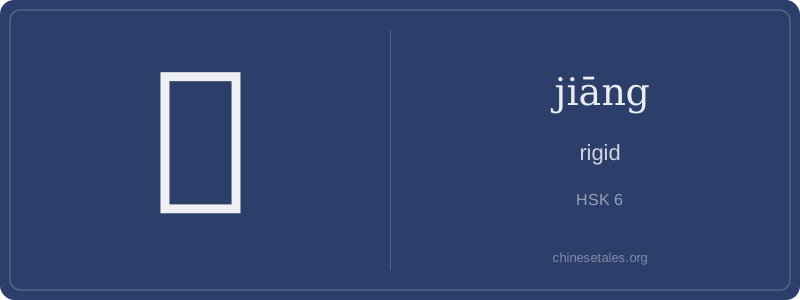
The earliest form of 僵 appears in Warring States bamboo slips as a compound: left side 亻 (person radical), right side 強 (qiáng, 'strong') — but crucially, 強 itself was originally written with 虫 (insect) at the bottom, suggesting overwhelming, writhing force. Over centuries, 強 simplified, losing the insect, and the right side of 僵 gradually morphed into 僵’s current shape: 亻 + 僵 (a stylized 強 minus 虫, plus a subtle 'frozen' twist in the final strokes — notice how the last four strokes (丿一丿丨) look like stiff, parallel rods, not flowing lines).
This visual evolution mirrors its semantic journey: from 'a person made immovably strong' → 'a person locked by excessive strength' → 'a person paralyzed by tension'. By the Han dynasty, 僵 already meant 'stiffened corpse' in medical texts like the Huangdi Neijing; by the Ming, it expanded metaphorically — in Journey to the West, Sun Wukong ‘freezes’ enemies with spells described as 僵住. The character’s very structure — human + frozen strength — became a perfect vessel for China’s cultural preoccupation with balance: too much rigidity, like too little, breaks the Dao.
Think of 僵 (jiāng) as the Chinese equivalent of a 'frozen robot mid-glitch' — not just stiff, but unnervingly rigid, locked in place by internal tension or external force. Unlike English 'rigid' (which can be neutral or even positive, like 'rigid standards'), 僵 carries visceral, often negative weight: it implies paralysis, lifelessness, or a breakdown in flow — whether in a body, a negotiation, or a system. You’ll rarely see it alone; it almost always appears in compounds like 僵硬 (jiāngyìng, 'stiff/rigid') or 僵持 (jiāngchí, 'deadlocked').
Grammatically, it’s strictly an adjective or part of a verb compound — never a standalone verb ('to僵') or noun. Learners mistakenly try to use it like 'stiffen' (e.g., *他僵了), but that’s ungrammatical; instead, you say 他僵住了 (tā jiāng zhù le) — the 把-structure or resultative complement is essential. It also never modifies nouns directly without a modifier: say 僵硬的手臂, not *僵手臂.
Culturally, 僵 evokes deep unease — tied to traditional beliefs about qi stagnation (causing physical rigidity) and social 'deadlock' (e.g., diplomatic 僵局). A classic learner trap is confusing it with 疆 (border) or 桨 (oar) due to similar sound — but more dangerously, misreading 僵持 as 'strongly holding', missing its connotation of futile, exhausting stalemate — like two sumo wrestlers frozen in mutual push, neither yielding nor falling.