时
Character Story & Explanation
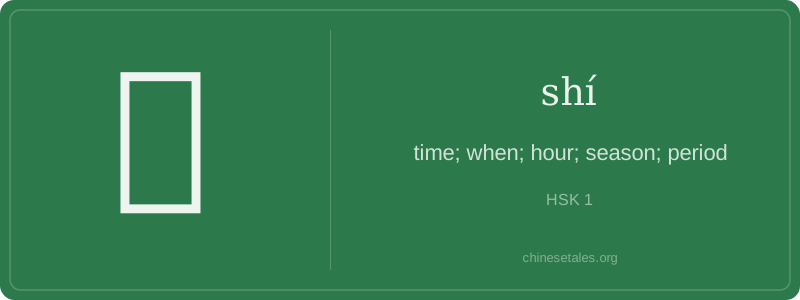
Oracle bone inscriptions show 时’s earliest form as a sun (日) above a simplified drawing of a hand holding a ceremonial staff or marker—symbolizing the act of observing and marking the sun’s position to tell time. By the bronze script era, the lower part morphed into 寺, a character originally depicting a hand placing something on a platform—evoking ‘setting’ or ‘fixing’ the moment. Over centuries, strokes streamlined: the top sun remained clear, while 寺 lost its hand element and gained symmetry, settling into today’s clean 7-stroke form: 日 + 寺. Even now, you can trace the sun’s authority—time isn’t invented; it’s witnessed.
This visual logic shaped its meaning. In the Classic of Poetry (Shījīng), 时 appears in lines like ‘四时之景不同’ (‘The scenery of the four seasons differs’)—here, 时 already meant ‘season,’ rooted in solar cycles. Confucius used 时 in ‘君子待时而动’ (‘A noble person waits for the right moment to act’), revealing how deeply 时 intertwines time with moral readiness. The character didn’t just measure hours—it measured harmony: between heaven and earth, action and stillness, human effort and celestial rhythm. That ancient sun still shines in every clock face and calendar in modern China.
At its heart, 时 (shí) is all about time—not abstractly, but concretely: the sun’s journey across the sky. Its radical 日 (rì, 'sun') anchors it in the observable world, while the right side 寺 (sì, originally meaning 'to hold' or 'station') evolved into a phonetic component that also subtly suggests ‘fixed position’—like the sun at noon, or an hour marked on a sundial. So 时 isn’t just ‘time’ as a philosophical concept; it’s time measured, scheduled, and socially shared: ‘What time is it?’, ‘at that time’, ‘in springtime’.
Grammatically, 时 shines in two HSK 1 roles: first, as a noun meaning ‘hour’ or ‘time’ (e.g., 几点?几点了?), and second, as a structural particle in phrases like …的时候 (…de shíhou, ‘when…’), where it turns any clause into a temporal anchor—‘When I eat, I drink tea.’ Learners often overuse 时 alone (saying *我吃饭时* instead of 我吃饭的时候) or misplace it before verbs without the 的…时候 frame. Remember: standalone 时 is fine in compounds (小时, 时代) or time nouns (这时, 那时), but not for ‘when’ clauses without the full structure.
Culturally, 时 reflects China’s ancient agrarian precision—seasonal timing dictated planting and rituals, so 时 carries quiet urgency: ‘timeliness’ (适时 shìshí) isn’t polite—it’s survival. A common slip? Pronouncing it as ‘sí’ (missing the retroflex sh-), which can confuse listeners—especially since 吃 (chī, ‘eat’) sounds similar. Also, avoid translating English ‘time’ one-to-one: ‘Have a good time!’ is 玩得开心 (wán de kāixīn), never *有好时!* — 时 simply doesn’t do ‘fun time’.