兢
Character Story & Explanation
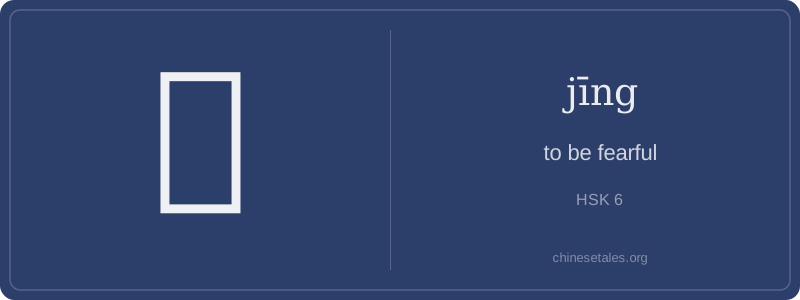
The earliest form of 兢 appears in bronze inscriptions as two facing ‘person’ (人) glyphs stacked vertically, each with bent knees — a stylized image of two figures bowing deeply to each other in ritual humility. Over time, the top person simplified into two parallel strokes (一 一), the middle became a horizontal stroke (一), and the lower person evolved into the radical 儿 (ér), representing a crouching figure — hence the modern structure: two ‘heads’ (the double 二-like top) over the ‘body’ (儿). The 14 strokes encode this duality: six for the upper ‘twin heads’, two for the connecting bar, and six for the kneeling figure below.
This visual duality directly shaped its meaning: mutual reverence between equals — not fear of a superior, but the shared, trembling awareness of moral stakes in relationship. In the *Book of Documents* (Shàngshū), rulers are urged to govern ‘with 兢’ — meaning with unwavering self-watchfulness. By the Tang dynasty, it crystallized into the reduplicated adverb 兢兢, used by poets like Bai Juyi to describe the meticulous care of a loyal minister. Its power lies precisely in that paradox: fear not of danger, but of *carelessness* — a uniquely cultivated, socially embedded dread of moral slippage.
At its core, 兢 (jīng) isn’t just ‘fear’ in the sweaty-palm, heart-racing sense — it’s the deep, quiet tremor of *reverent awe*: the kind you feel standing before a master craftsman’s flawless work, or reading a line of Du Fu so precise it feels like moral gravity made visible. This is fear as ethical vigilance — not panic, but hyper-awareness of consequence, responsibility, and one’s place in a delicate order. It’s profoundly Confucian: fear not of punishment, but of failing your role.
Grammatically, 兢 almost never stands alone. It’s fossilized in classical compounds like 兢兢 (jīng jīng), where reduplication intensifies the sense of meticulous, trembling care — think ‘walking on eggshells while polishing porcelain’. You’ll find it in formal writing and set phrases (e.g., 兢兢业业), never in casual speech like ‘I’m scared’. Learners often mistakenly use it as a standalone verb (‘I fear…’) — a fatal error; it’s purely adverbial or adjectival in modern usage, always paired.
Culturally, 兢 reveals how Chinese thought links moral rigor with physical posture: the character’s ‘two heads’ (two 儿 radicals) evoke two people bowing low in mutual respect — not submission, but shared accountability. Mistake it for ‘anxiety’, and you miss the dignity; confuse it with ‘nervousness’, and you erase its ethical weight. It’s the quiet hum beneath China’s emphasis on diligence, precision, and face-saving — fear as the engine of excellence.