勘
Character Story & Explanation
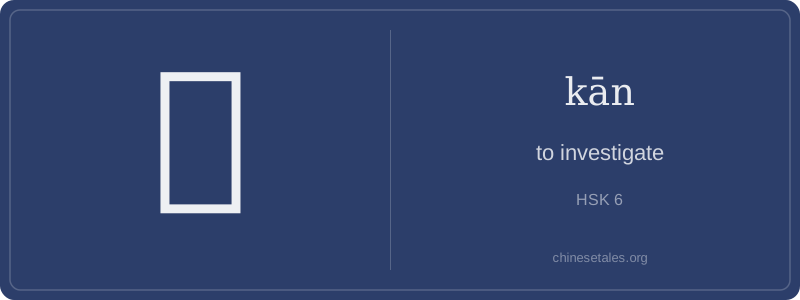
The earliest form of 勘 appears in Warring States bamboo slips as a compound: 工 (gōng, 'craft, work') above 口 (kǒu, 'mouth' — here likely representing speech or verbal verification) and below 力 (lì, 'strength'). Over centuries, 工 evolved into 甚 (shèn, 'excessive, thorough'), while 口 fused visually with the top stroke of 力 — giving us today’s structure: 甚 over 力. Crucially, the 11 strokes aren’t arbitrary: the top 甚 contains 7 strokes (hinting at exhaustive attention), and 力 contributes 2 decisive strokes — a sharp hook and firm dot — embodying resolve.
This evolution mirrors its semantic journey: from concrete 'on-site verification by craftsmen' to abstract 'authoritative examination'. By the Tang dynasty, 勘 was standard in legal codes for judicial inspection (e.g., 勘验尸伤, 'examining corpses and wounds'). In the 11th-century *Dream Pool Essays*, Shen Kuo used 勘 to describe cross-checking astronomical records — showing how early Chinese science embedded verification into methodology. Visually, the character still feels like a person leaning in, eyes narrowed, hand gripping a surveyor’s rod: 力 literally anchoring inquiry to the ground.
At its heart, 勘 (kān) is about *focused, hands-on scrutiny* — not passive observation, but the kind of investigation that requires physical presence, mental rigor, and often professional authority. Think forensic experts at a crime scene, geologists mapping fault lines, or editors verifying historical sources: it’s labor-intensive truth-seeking. The radical 力 (lì, 'strength') isn’t decorative — it signals that this act demands effort, discipline, and even moral weight.
Grammatically, 勘 is almost always transitive and formal. You don’t ‘勘’ something casually; you 勘查 (kānchá) terrain, 勘验 (kānyàn) evidence, or 勘误 (kānwù) a textbook — always with purpose and accountability. Learners often mistakenly use it like the more general 调查 (diàochá), but 勘 implies technical precision and institutional legitimacy. It rarely appears in spoken, colloquial contexts — you’d say ‘check’ or ‘look into’ in English, but write 勘 only in reports, legal documents, or academic papers.
Culturally, 勘 carries the quiet gravity of China’s long tradition of scholarly verification and bureaucratic diligence. In classical texts, it appeared in imperial edicts ordering land surveys or textual collation of Confucian classics — acts that upheld cosmic and social order. A common learner trap? Confusing it with 看 (kàn, 'to look') or 刊 (kān, homophone meaning 'to publish'). The former is too vague; the latter shares the sound but none of the investigative muscle. Remember: if no 力 is involved, it’s probably not 勘.