到
Character Story & Explanation
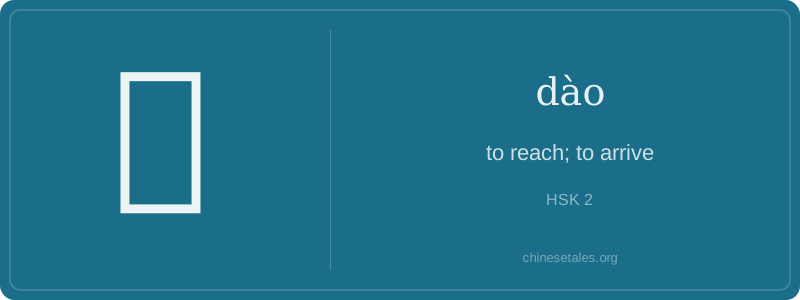
The earliest form of 到 appears in bronze inscriptions as a compound: the left side was 至 (zhì), depicting an arrow hitting a target — symbolizing ‘reaching the endpoint’ — and the right side was 刂 (a knife radical), added later to emphasize decisive arrival, like a blade cutting through distance or hesitation. Over centuries, 至 simplified: its top stroke became the dot and horizontal line (⺅), the middle turned into the bent stroke (), and the bottom evolved into the two short strokes and the final vertical hook — forming today’s 刂 on the right. The left side condensed from 至’s full form into the compact 至-like shape we see now: the dot, the bent stroke, and the two small strokes below.
This visual evolution mirrors its semantic journey: from concrete archery precision (‘arrow arrives at target’) to broad human experience (‘I arrive at school,’ ‘She reached enlightenment,’ ‘We got to the point’). In the *Analects*, Confucius uses 至 (the ancestor of 到) to describe moral attainment: ‘知之为知之,不知为不知,是知也’ — true knowledge means knowing when you’ve *reached* understanding. Though 到 itself isn’t in classical texts, its modern dominance reflects how deeply Chinese values prize completion, presence, and purposeful arrival — not just motion, but meaningful landing.
Imagine you’re sprinting across Beijing’s Forbidden City courtyard, heart pounding — not because you’re late for a meeting, but because your friend just texted: ‘I’m at the Meridian Gate!’ You burst through the gate, breathless, and shout: ‘I’ve arrived!’ — that triumphant, grounded *dào* is 到. It’s not just ‘to arrive’ like a GPS ping; it’s the physical, emotional, or even abstract *completion of movement toward a goal*. It marks arrival at places (北京到了), people (见到老师了), states (想到办法了), or time points (到八点了). Unlike English, 到 almost never stands alone — it needs context: a location, a person, a result, or a time.
Grammatically, 到 loves company. With locations? Add 上, 下, or in: 坐地铁到学校 (zuò dìtiě dào xuéxiào). With results? Pair it with verbs like 看见 or 想出: 终于想到答案了 (zhōngyú xiǎng dào dá'àn le). Learners often mistakenly use 到 where they need 在 (zài) for ‘being at’, or confuse it with 到达 (dàodá) — which is formal and rarely used in speech. Also: no ‘to’ before 到! Saying ‘I want to arrive’ is 我想到达 — but in daily talk? Just 我想去北京 (wǒ xiǎng qù Běijīng), then later, 北京到了!
Culturally, 到 carries quiet weight: it signals completion, presence, readiness — think of a teacher saying ‘同学们都到齐了’ (all students have arrived) — it’s not just attendance, it’s the moment learning can begin. A common slip? Using 到 instead of 了 after action verbs (e.g., *我吃到了* vs. *我吃了*). The former implies ‘I managed to eat [something hard to get]’ — nuance matters!