吝
Character Story & Explanation
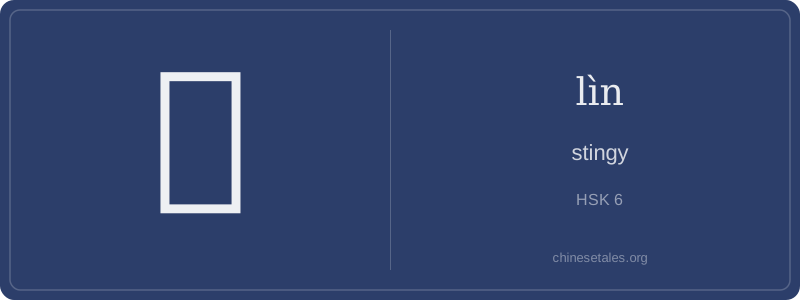
The earliest form of 吝 appears in Warring States bamboo slips—not as a pictograph, but as a phonosemantic compound. Its left side 口 (kǒu, 'mouth') hints at speech or expression; its right side 文 (wén, 'pattern, writing') originally doubled as a phonetic component (wèn → lìn via historical sound shift). Over time, 文 simplified: the top dot and crossbar fused into two short horizontal strokes, and the lower 'X' shape collapsed into the modern 乂-like stroke — yielding today’s clean 7-stroke form: 口 + 乂 (a stylized, compact 文).
This evolution mirrors its semantic journey: from classical texts like the Yi Jing (Book of Changes), where 吝 described 'difficulty in progress' or 'obstruction' (e.g., 'six at third place: 吝'), it gradually narrowed to mean 'withholding'—especially of words, favor, or resources. By the Han dynasty, it carried strong ethical weight: to 吝 is to choke off the natural flow of virtue, like sealing a spring. The mouth radical isn’t about greed—it’s about *refusing to open* one’s mouth to speak kindly, share wisdom, or offer grace.
Think of 吝 (lìn) as Chinese Mandarin’s version of Scrooge McDuck diving into his money bin—but with a twist: it’s not just about hoarding cash. It’s about withholding *anything* valuable—time, praise, kindness, even oxygen in a metaphorical sense. In English, 'stingy' feels mostly financial; in Chinese, 吝 carries a sharper moral edge, implying pettiness, emotional tightfistedness, or even intellectual miserliness—like refusing to share knowledge. It’s rarely used alone; you’ll almost always see it in compounds like 吝啬 (lìn sè) or 吝惜 (lìn xī), where it intensifies the judgment.
Grammatically, 吝 is nearly always adjectival or verbal within compound words—it doesn’t function like an independent adjective ('He is 吝') the way 'stingy' does in English. You’d say 他很吝啬 (tā hěn lìn sè), not *他吝. And crucially: never use 吝 for 'reluctant' in neutral contexts—e.g., 'I’m reluctant to speak up' is 不好意思 (bù hǎo yì si) or 有所顾虑 (yǒu suǒ gù lǜ), *not* 吝于表达. That would sound bitterly accusatory, like calling someone morally bankrupt over a shy comment.
Culturally, 吝 taps into Confucian ideals of generosity (shù 恕) and reciprocity (shù 恕 / rén 仁). To be 吝 is to violate social harmony—not just being cheap, but failing your human duty to circulate goodwill. Learners often misapply it after English 'reluctant', or confuse it with characters like 易 (yì, 'easy') due to similar top strokes—both errors instantly signal non-native fluency. Use 吝 only when you mean *judgmental stinginess*, not mere hesitation.