吟
Character Story & Explanation
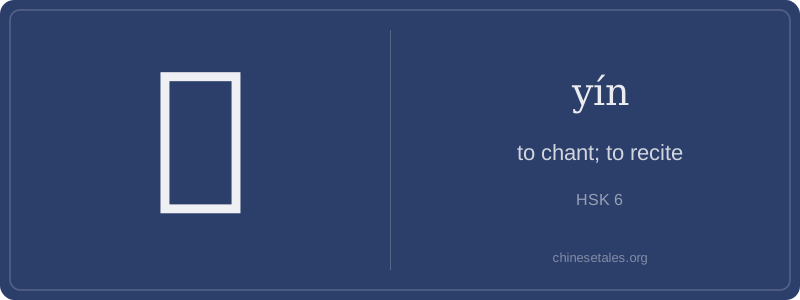
The earliest form of 吟 appears in bronze inscriptions as a combination of 口 (kǒu, ‘mouth’) and 今 (jīn, ‘now’ — originally a pictograph of a lid or cover over a vessel). In oracle bone script, 今 resembled a downward-curving line with a dot — evoking the shape of a mouth releasing sound *in the present moment*. Over centuries, the top part standardized into 今’s modern shape, while 口 remained firmly anchored at the left — visually anchoring the idea of ‘sound issuing now from the mouth’. By the Han dynasty, the seven-stroke structure was fixed: three strokes for 口, four for 今 — a perfect balance of breath and immediacy.
This visual logic deepened its meaning: 吟 came to signify not just speaking, but vocalizing *with sustained, melodic intention* — like chanting a poem so deeply felt that time seems to pause. Classical texts abound with it: Li Bai’s famous line ‘低眉信手续续吟’ (dī méi xìn shǒu xùxù yín, ‘Head bowed, hands moving freely, he chants on and on’) captures its meditative flow. The character’s very structure — mouth + ‘now’ — reminds us that true 吟 happens only in the living, breathing present: no rehearsal, no recording — just voice meeting moment.
At its heart, 吟 (yín) isn’t just ‘to recite’ — it’s to voice poetry *with feeling*, like a low, resonant hum that vibrates in the chest. Unlike 读 (dú, ‘to read aloud’), which is neutral and functional, 吟 implies artistry, rhythm, and emotional resonance: you don’t 吟 a grocery list — you 吟 a Tang dynasty quatrain at dusk, swaying slightly, syllables drawn out like ink bleeding on rice paper. It’s inherently literary and performative.
Grammatically, 吟 is a transitive verb but often appears without an object when context is clear (e.g., 他独自吟||tā dúzì yín — ‘He chants alone’). It rarely takes aspect markers like 了 or 过 unless emphasizing completion of a specific recitation; instead, it leans on adverbs like 深情地 (shēnqíng de, ‘emotionally’) or 缓缓地 (huǎn huǎn de, ‘slowly’). Learners mistakenly use it for everyday speech — no one 吟s a weather report! Also, it’s almost never used in imperative commands (don’t say ‘你快吟!’ — it sounds like summoning a spirit).
Culturally, 吟 reflects the ancient Confucian ideal that poetry isn’t passive reading — it’s embodied practice, linking breath, voice, and moral cultivation. In classical education, students didn’t just memorize poems; they 吟 them aloud daily to internalize cadence and virtue. Even today, elderly poets in Beijing parks 吟 Du Fu at dawn — not for an audience, but as spiritual hygiene. A common learner trap? Overusing 吟 where 诵 (sòng, ‘to recite formally’) or 朗读 (lǎngdú, ‘to read aloud clearly’) would be more appropriate.