哄
Character Story & Explanation
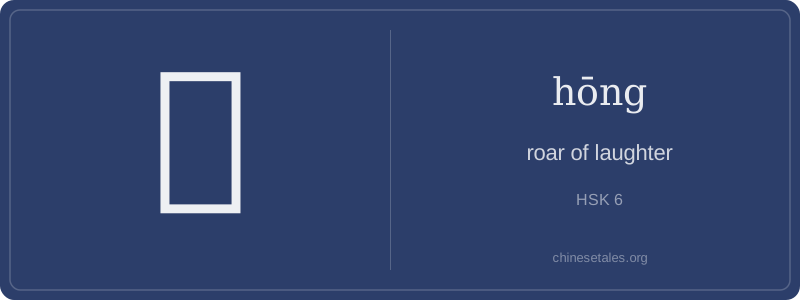
The earliest form of 哄 appears in late Warring States bronze inscriptions as a combination of 口 (mouth, speech/sound) and 共 (gòng, ‘together’, ‘in common’), with no extra strokes. In seal script, 共 was stylized into two hands reaching upward, symbolizing collective action — here, collective vocalization. By the Han dynasty clerical script, the shape stabilized: 口 firmly anchored at left, and 共 simplified to its modern nine-stroke form — three horizontal lines above two vertical strokes, evoking converging voices rising in unison. The radical 口 isn’t decorative: it’s the acoustic chamber, the source of the sound.
This visual logic drove its semantic evolution. Originally, 共 implied joint participation — so 哄 meant ‘voices raised together’, whether in praise, protest, or, most vividly, in irrepressible laughter. By the Tang dynasty, it was already fixed in idioms like 哄堂大笑, appearing in poetry by Bai Juyi to describe courtiers’ synchronized, thunderous mirth. The character never meant ‘individual chuckle’ — its essence is plurality, volume, and shared release. Its shape literally spells out ‘mouths acting in concert’ — a rare case where etymology and usage remain perfectly aligned across 2,300 years.
Imagine a packed teahouse in old Beijing — bamboo chairs scraping, steam rising from clay pots, and suddenly, a storyteller cracks a joke so sharp it triggers a full-room hōng: not just laughter, but a deep, resonant, almost physical *roar* — like thunder rolling across a valley. That’s 哄 (hōng): it doesn’t mean ‘laugh’; it’s the collective, involuntary, gut-level *sound* of mass mirth erupting at once. It’s onomatopoeic and visceral — you feel it in your ribs.
Grammatically, 哄 is almost always used as a verb in reduplicated form: hōng hōng (哄哄), or embedded in compound verbs like hōng táng dà xiào (哄堂大笑 — ‘roar with laughter’). Crucially, it’s rarely used alone: you won’t say ‘he 哄’ — you’ll say ‘the whole room hōng hōng’. Learners often mistakenly use it like 笑 (to laugh), or confuse its tone — hōng (first tone) is *only* for the roar of laughter; hǒng means ‘to coax’ (as in 哄孩子), and hòng means ‘to stir up trouble’ — totally different semantic worlds.
Culturally, this character captures a deeply Chinese social rhythm: laughter as shared, embodied, even slightly unruly energy — not private amusement, but communal resonance. It appears in classical texts like the Shuō Yuàn, where ministers’ collective laughter signals spontaneous, unscripted approval. A common error? Writing 哄 when you mean 洪 (hóng, ‘flood’) — same sound, wildly different meaning. Remember: 口 + 共 = mouth + together = voices joined in one booming wave.