可
Character Story & Explanation
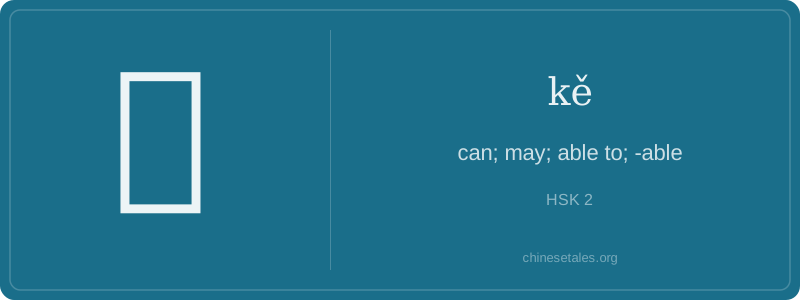
The earliest form of 可 appears in Shāng dynasty oracle bone inscriptions as a pictograph combining 口 (mouth, symbolizing speech or command) and 丂 (a bent, hooked shape representing a tool or ritual implement). Scholars believe it depicted a ceremonial staff inserted into a mouth-shaped vessel — visual shorthand for 'words sanctioned by authority', hence 'permissible'. Over centuries, the hook simplified into the modern 亅 (a downward stroke with a hook), while 口 remained intact — five strokes total: 一 (horizontal), 丨 (vertical), 丿 (left-falling), 口 (enclosed square), and 亅 (hooked ending).
This ancient link between speech and sanction carried into classical usage: in the Book of Rites, 可 appears in phrases like 'lǐ kě yě' (ritual propriety is permissible), reinforcing its role in socially approved conduct. Its visual simplicity — just a mouth plus a decisive hook — mirrors its semantic power: a single stroke transforms speech into legitimacy. Even today, when you write 可, you’re echoing an ancient ritual gesture: the moment a chieftain nods and affixes his seal to a decree.
Think of 可 (kě) as Chinese’s Swiss Army knife of permission and possibility — like the word 'may' in English legal documents or 'can' in casual speech, but with a lighter, more flexible vibe. It doesn’t shout authority; it opens doors politely. Unlike English ‘can’, which often implies physical ability ('I can lift this box'), 可 carries a subtle blend of permission ('You may enter'), feasibility ('It’s possible'), and even mild approval ('That’s acceptable').
Grammatically, it’s deceptively simple: placed before a verb, it turns any action into something permitted or doable — no conjugation, no tense changes. 'Wǒ kěyǐ qù' (I can go) works identically for past, present, or future context — time is handled by other words (e.g., zuótiān, míngtiān). Learners often overuse 可 and forget that in many spoken contexts, native speakers drop it entirely for brevity: 'Qù ma?' (Shall we go?) already implies possibility — no 可 needed! Also, never pair it with negation as 'bù kě' unless quoting formal texts; use bù kěyǐ instead.
Culturally, 可 reflects Confucian pragmatism: it signals openness without overcommitment — a linguistic shrug that says 'Yes, *if* conditions allow.' That’s why you’ll see it in bureaucratic phrases like 'kě xíng' (feasible) or 'kě néng' (possible), where certainty is deliberately softened. A common mistake? Using 可 alone to mean 'yes' — it’s not a standalone affirmation like 'shì' or 'hǎo'; it must modify a verb or adjective.