哦
Character Story & Explanation
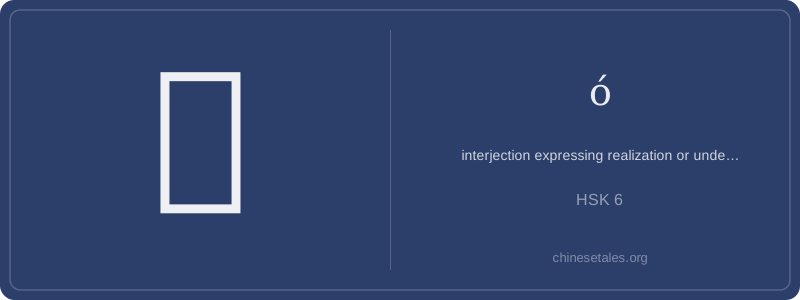
The character 哦 has no ancient oracle bone or bronze script form — it’s a latecomer, born during the Ming-Qing transition as vernacular fiction exploded. Its left side 口 (kǒu, 'mouth') is straightforward: all speech-related characters wear this radical like a badge. The right side 曷 (hé), however, is the star: originally a pictograph combining ‘to ask’ (盍) and ‘what?’ (何), it evolved into a phonetic component meaning 'why?' or 'how?'. When fused with 口, it didn’t mean 'how do you say?' — instead, it captured the vocalized *response* to that question: the sigh-like exhalation of sudden insight.
By the 17th century, in novels like Golden Lotus, 哦 appeared in dialogue to transcribe spontaneous vocal reactions — not written narration, but *heard* speech. Its shape mirrors its function: the compact 口 anchors the sound, while 曷’s complex strokes (10 total) visually echo the subtle tension-release of realization — like a quick intake followed by a relaxed, open-mouthed exhale. Confucian texts never used it; it’s a rebel character, forged in the messy, living breath of everyday conversation.
Think of 哦 (ó) as Chinese’s verbal equivalent of a lightbulb flickering on over someone’s head — not the loud 'AHA!' of an epiphany, but the soft, slightly breathy 'Ohhh...' you make when a puzzle piece clicks into place mid-conversation. It’s not a word you plan; it’s the involuntary exhale of dawning comprehension, often trailing silence like a gentle ripple. Unlike English 'oh', which can signal surprise, disappointment, or greeting, 哦 is almost exclusively cognitive: it marks the moment understanding lands — and crucially, it’s rarely used at sentence beginnings in formal speech.
Grammatically, 哦 floats freely — usually as a standalone utterance ('Ó... wǒ míngbái le.'), or tacked onto the end of a clause to soften or confirm ('Nǐ shuō tā lái le? Ó...'). Learners often overuse it like English 'oh' — inserting it where native speakers would pause, nod, or simply say nothing. And beware tone: while ó (rising) signals realization, ò (falling) conveys reluctant acknowledgment ('Ó... hǎo ba'), and neutral o appears in casual speech or song lyrics — but HSK 6 focuses squarely on the 'lightbulb' ó.
Culturally, 哦 carries subtle social weight: too many ós sound passive or disengaged; too few can seem brusque. In phone calls or customer service, a well-timed ó shows active listening — but if drawn out ('óóó...'), it may hint at polite skepticism. Native speakers often pair it with eye contact and a slight head tilt — making it as much a gesture as a sound.