哑
Character Story & Explanation
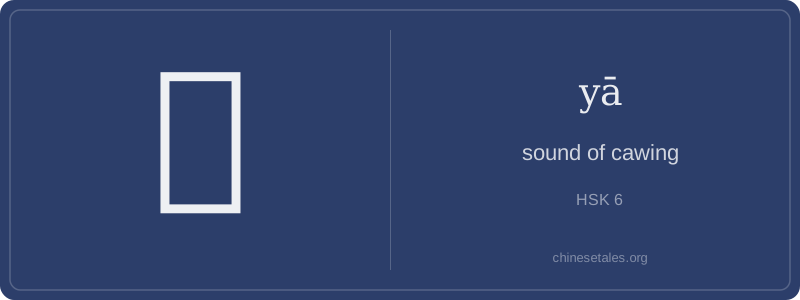
The earliest form of 哑 appears in bronze inscriptions as a combination of 口 (mouth) and 牙 (yá, ‘fang’ or ‘tooth’ — originally drawn as two sharp, interlocking teeth). This wasn’t dental anatomy — it was visual metaphor: teeth clashing like beaks, jaws snapping shut mid-cry. Over centuries, 牙 simplified into the current 又 (yòu, ‘again’) shape — losing its fang-like curves but keeping the sense of abrupt, repetitive action. The 口 radical stayed firmly anchored at the left, emphasizing that this was fundamentally about *vocal output*, not thought or hearing.
By the Warring States period, 哑 had shifted from pure onomatopoeia to imply *involuntary, unmodulated sound* — the kind that escapes before reason catches up. In the Zhuāngzǐ, it describes the ‘dumbfounded silence after a shocking truth’ (哑然失笑 yǎrán shīxiào — ‘speechless, then bursting into laughter’), showing how the character bridged physical sound and psychological rupture. Its visual simplicity — just 9 strokes — belies this layered evolution: from crow’s beak to human awe.
At first glance, 哑 (yā) might seem like a simple onomatopoeic character — the cawing of crows or harsh, grating sounds — but it’s actually a linguistic time capsule. In classical Chinese, it carried visceral weight: not just noise, but *disrupted* or *uncontrolled* vocalization — the raw, unrefined cry of animals or emotionally overwhelmed humans. That’s why it appears in texts like the Shuōwén Jiězì (121 CE) as ‘the sound of crows quarreling’ — less about pitch, more about chaos and social dissonance.
Grammatically, it’s almost always used as a noun or adjective in compound words (e.g., 哑巴 yǎba ‘mute person’, 哑然 yǎrán ‘speechless’), never standalone in modern speech. Learners often mistakenly use it as a verb meaning ‘to become mute’ — but that’s incorrect; you’d say 失声 (shīshēng) or 说不出话来 (shuō bu chū huà lái). Also, note the tone shift: while yā means ‘cawing’, yǎ (third tone) is used only in fixed compounds like 哑然 — never for animal sounds.
Culturally, this character reveals how deeply Chinese associates vocal control with virtue: silence isn’t neutral — it’s either cultivated (静 jìng) or pathological (哑 yǎ). Mistaking 哑 for quietness (e.g., confusing it with 静 or 沉) risks sounding comically ominous — like calling someone ‘crow-cawing’ instead of ‘calm’. And yes — if your friend says ‘他今天很哑’, they’re not describing his voice, they’re accidentally implying he’s squawking like an angry crow!