喘
Character Story & Explanation
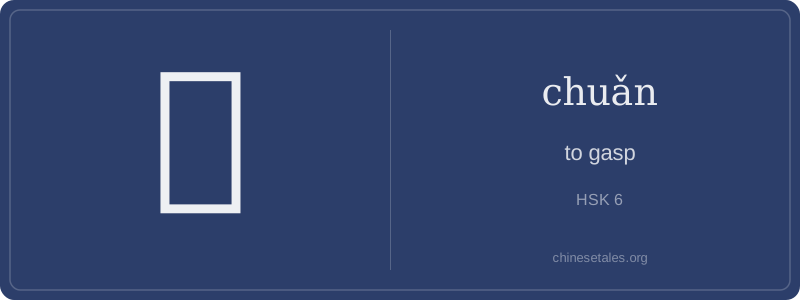
The earliest form of 喘 appears in Warring States bamboo slips as a combination of 口 (kǒu, 'mouth') and 端 (duān, 'end, tip') — not as a semantic-phonetic compound we see today, but as a phonetic loan. By Han dynasty seal script, it stabilized into its current structure: 口 on the left, indicating speech or breath-related action, and 奄 (yǎn, 'to cover, suppress') on the right — visually suggesting breath constricted, smothered, or cut short. The 12 strokes trace this compression: the top of 奄 looks like a roof (宀) pressing down, with a bent person (大) underneath — literally 'breath pinned.'
This visual metaphor shaped its meaning deeply: in the Shuōwén Jiězì (121 CE), Xu Shen defined 喘 as 'rapid, shallow breathing due to exhaustion or illness' — already emphasizing physiological distress. By Tang poetry, it became a literary shorthand for emotional rupture: Du Fu wrote of soldiers ‘血流成河,气喘难续’ (blood flowed like rivers, breath too strained to continue), tying physical collapse to moral gravity. The character’s shape remains a silent scream — mouth open, air trapped mid-inhalation.
At its core, 喘 (chuǎn) isn’t just ‘to gasp’ — it’s the visceral, urgent sound of breath breaking under strain: labored inhalation after a sprint, a sharp intake before bad news, or the ragged rhythm of exhaustion. Unlike generic ‘breathe’ (呼吸 hūxī), 喘 is inherently *disrupted* breathing — noisy, involuntary, and emotionally charged. It carries weight, tension, and vulnerability; you’d never use it for calm meditation, only for moments when the body betrays composure.
Grammatically, 喘 is almost always a verb, commonly appearing in reduplicated form (喘喘 chuǎn chuǎn) to intensify urgency, or as part of compound verbs like 喘不过气来 (chuǎn bu guò qì lái — 'can’t catch one’s breath'). It rarely stands alone in formal writing but thrives in vivid narration: ‘他跑上楼,喘着粗气’ (He ran up the stairs, gasping heavily). Learners often misapply it as a noun ('a gasp') — but Chinese doesn’t treat it that way; instead, use 喘息 (chuǎnxī) for 'a brief respite' or 'panting' as a noun.
Culturally, 喘 appears frequently in classical medical texts (e.g., the Huangdi Neijing) describing pathological breathing patterns — linking breath to qi imbalance. Modern usage retains that diagnostic precision: 喘鸣 (chuǎnmíng, 'wheezing') signals asthma, while 心慌气喘 (xīnhuāng qì chuǎn, 'palpitations and shortness of breath') evokes anxiety. A common mistake? Using 喘 where 吸 (xī, 'to inhale') or 呼 (hū, 'to exhale') fits — but those are neutral; 喘 is always *distressed* air.