也
Character Story & Explanation
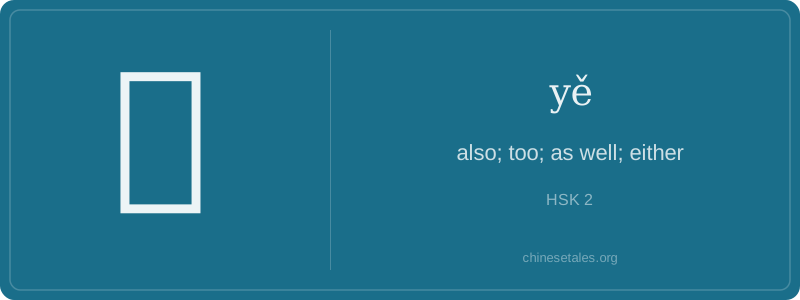
Carved onto oracle bones over 3,200 years ago, the earliest form of 也 resembled a coiled serpent or a stylized female genitalia — scholars still debate which — enclosed within a rounded, protective enclosure. This wasn’t random: in Shāng dynasty cosmology, such forms symbolized fertility, continuity, and shared essence — the idea of ‘being of the same kind.’ Over centuries, the enclosure simplified into the curved hook 乚 (yǐn), while the inner elements streamlined into two short strokes — first a dot-like mark, then a horizontal line, finally merging into today’s elegant, minimalist 也: a single sweeping curve (the radical 乚) crowned by two tiny, balanced strokes.
By the Warring States period, 也 had shifted from a concrete symbol to a grammatical particle meaning ‘indeed,’ ‘truly,’ or ‘likewise’ — used at sentence ends in classical texts to affirm shared truth (e.g., 学而时习之,不亦说乎?— ‘Is it not delightful…?’). Its modern additive sense emerged gradually: from ‘this is truly so, as others are’ → ‘this is so, and others are too.’ The visual simplicity mirrors its function: no frills, no ambiguity — just quiet, essential connection. Even Confucius used it this way in the Analects to bind moral claims across people and time.
At first glance, 也 looks disarmingly simple — just three strokes — but it’s one of Chinese’s stealthy grammatical workhorses. Its core feeling isn’t flashy; it’s quiet insistence: 'me too,' 'same here,' 'not alone.' Unlike English ‘also’ which often starts a clause (‘Also, I like tea’), 也 almost always sits *right before the verb*, tightly bound to the predicate — think 我也去 (wǒ yě qù, ‘I also go’), never *我也*去. Drop it in the wrong spot? You’ll sound like a robot translating word-for-word.
Grammatically, 也 is a modal adverb that expresses addition or shared status — but crucially, it *requires a prior context or implied contrast*. You can’t say *我也* out of the blue; someone must have just said ‘I like coffee,’ and then you reply 我也喜欢 (wǒ yě xǐhuān). It’s relational, not standalone. Learners often overuse it (e.g., saying *今天我也* for ‘today also’) — but 也 doesn’t mean ‘also’ in time sequences; for that, use 还 (hái) or 又 (yòu). And no, it’s not interchangeable with 都 (dōu) — that’s about universality ('all'), while 也 is about inclusion ('me too').
Culturally, 也 carries subtle humility: asserting shared experience rather than individual action. In classical texts, it often softens assertions — like adding ‘as others do’ to avoid sounding arrogant. A classic learner trap? Confusing it with 他 (tā, ‘he’) or 也 (yě) vs. 乜 (niè, an archaic interrogative particle). But the biggest hiccup? Forgetting that 也 *demands parallel structure*: if the first clause uses 是 (shì), the second must too — 我是老师,他也是老师 (wǒ shì lǎoshī, tā yě shì lǎoshī), not *他也是老师* without the second 是.