啬
Character Story & Explanation
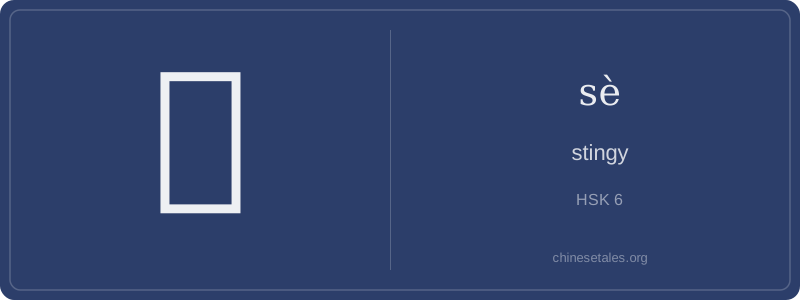
The earliest form of 啬 appears in bronze inscriptions as ⿱㐭卩 — a granary (㐭, later simplified to 囗+㐭) with a kneeling figure (卩) inside, sealing or guarding it. Over centuries, the granary roof evolved into the top 十 (shí, 'ten'), while the lower part condensed: the kneeling figure became 口 (mouth/enclosure) plus 冂 (a boundary), then further stylized into 師 without the left hand — eventually settling into today’s 十 + 丨 + 口 + 冂 + 一. Crucially, the 'ten' radical isn’t numeric — it’s a *roof beam*, echoing the granary’s structure.
This origin explains everything: 啬 wasn’t born from psychology but agrarian survival. In the Book of Rites, 啬 described the careful harvesting and storing of millet — not hoarding, but *sacred thrift*. By the Warring States period, philosophers like Laozi repurposed it ethically: '治人事天,莫若啬' ('In governing people and serving Heaven, nothing surpasses 啬') — now meaning conservation of inner virtue. The character’s visual austerity mirrors its semantic austerity: every stroke seals, restricts, preserves.
At first glance, 啬 (sè) means 'stingy' — but that English word is too flat and moralistic. In Chinese, 啬 carries a richer, almost agricultural weight: it’s about *tight control over resources*, whether money, time, energy, or even breath. Think less 'miserly Scrooge' and more 'a farmer hoarding grain before winter' — not out of greed, but deep-seated prudence. This nuance matters: calling someone 啬 isn’t always an insult; in classical contexts like the Tao Te Ching, 啬 describes virtuous self-restraint — conserving vital energy (qi) to live long and well.
Grammatically, 啬 is almost always an adjective, but unlike most adjectives, it rarely stands alone. You’ll seldom hear just '他很啬' — it feels incomplete. Instead, it appears in compounds (like 吝啬 or 啬刻) or with intensifiers: 极其啬 (jíqí sè), 分外啬 (fènwài sè). It also appears in formal or literary registers — you’d use 吝啬 in everyday speech, but 啬 alone shows up in essays, historical analysis, or poetic critique of materialism.
Learners often misapply 啬 as a direct synonym for 小气 (xiǎoqì) — but 啬 is sharper, drier, and more judgmental. Worse, some confuse it with the positive-sounding 穰 (ráng, 'abundant') due to visual similarity — a hilarious reversal! Remember: 啬 has *no* warmth. Its tone (sè, fourth tone) is clipped and final, like slamming a grain chest shut.