坑
Character Story & Explanation
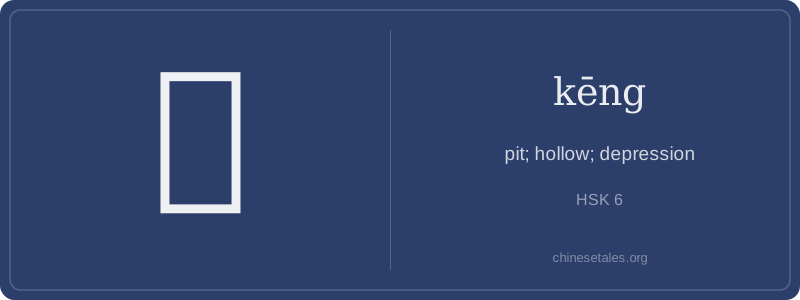
The earliest form of 坑 appears in bronze inscriptions as a simple pictograph: a square outline (representing the earth’s surface) with a downward stroke inside — unmistakably a dug-out cavity. By the seal script era, it evolved into 土 + 亢: the left side solidified as the 土 radical (soil/earth), while 亢 — originally a pictograph of a person’s raised neck (symbolizing prominence) — was repurposed phonetically and semantically: high ground collapsing *into* void. The modern standard form retains this elegant duality — seven strokes total: two horizontal earth lines, then the descending hook-and-dot of 亢, like a shovel plunging into soft soil.
This visual logic mirrors its semantic journey. In the *Zuo Zhuan*, 坑 appears in military contexts — ‘burying enemies alive’, linking hollows to violence and concealment. By the Tang dynasty, poets used it evocatively: Du Fu wrote of ‘empty pits’ left by war, where meaning itself had collapsed. Today, the character’s physical origin remains palpable — every time you say ‘I got 坑ed’, you’re invoking millennia of buried intentions, literal and linguistic.
Think of 坑 (kēng) as the ‘ground-level truth’ of Chinese — literally a depression in the earth, but emotionally? It’s where things go to vanish, stall, or get buried. The 土 radical (‘earth’) anchors it physically, while the 亢 (kàng) component hints at height-turned-hollowness: imagine a raised mound that suddenly collapses inward — that’s the visual and conceptual pivot. This isn’t just ‘pit’ like a pothole; it’s the hollow where you trip, the trapdoor beneath polite conversation, the unspoken expectation that swallows your effort whole.
Grammatically, 坑 shines as both noun and verb — and here’s where learners stumble. As a noun: ‘a pit’ (e.g., 煤矿坑 — coal mine shaft). As a verb: ‘to trick, to scam’ (e.g., 他被坑了 — He got scammed), a vivid metaphorical extension from ‘digging a trap’. Crucially, it’s almost never used neutrally for natural landforms like ‘valley’ or ‘basin’ — those are 沟, 谷, or 盆. Use 坑 for human-made, dangerous, or deceptive hollows — physical or moral.
Culturally, 坑 carries delicious irony: what starts as an agricultural term (digging pits for planting or storage) morphed into internet slang for ‘trap’ — as in 坑爹 (kēng diē, ‘scam-dad!’), a sarcastic outcry when something disappoints spectacularly. Learners often misread it as ‘trench’ or overuse it for benign depressions. Remember: if there’s no risk, no deception, or no human intent behind the hollow — it’s probably not 坑.