塞
Character Story & Explanation
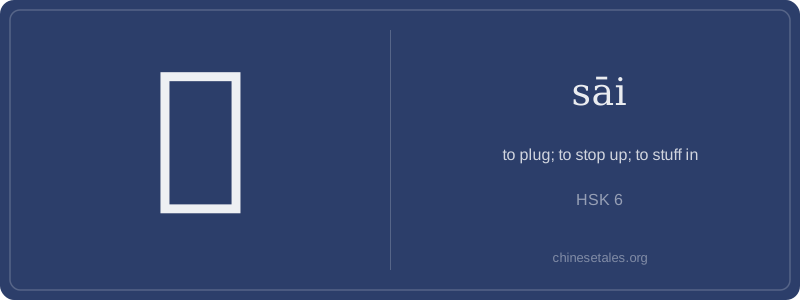
The earliest form of 塞 appears in bronze inscriptions as a complex pictograph: a 'mouth' (口) atop a 'hand' (又) pressing down onto a 'container' (宀 + 土), suggesting the act of forcing something into an enclosed space. Over time, the top simplified into the radical 宀 (roof), the middle became the hand-like component 畐 (fú, originally meaning 'full'), and the bottom solidified into 土 (earth/ground) — anchoring the idea of *filling a grounded vessel*. By the Han dynasty, the modern structure emerged: 宀 over 畐 over 土 — 13 strokes capturing containment, pressure, and earthy finality.
This visual logic shaped its semantic journey. In early texts like the *Zuo Zhuan*, 塞 described blocking mountain passes or damming rivers — literal, forceful obstruction. Later, in Tang poetry and Ming vernacular fiction, it expanded to emotional and metaphorical stuffing: '塞满心间' (sāi mǎn xīn jiān, 'stuff full of the heart') conveys overwhelming feeling. The character’s layered structure — roof (enclosure), fullness (pressure), earth (weight) — mirrors how Chinese conceptualizes 'plugging' not as mere covering, but as dense, grounded, irreversible insertion.
Think of 塞 (sāi) as Chinese’s version of a stubborn cork — not the elegant kind in a wine bottle, but the one you wrestle with at a picnic: jammed, resistant, and *definitely* not coming out without effort. Its core meaning — 'to plug', 'to stuff in', 'to block' — carries physical force and slight friction: it’s about *active resistance*, not passive closure. You don’t just ‘close’ a hole; you *force something into it* — like stuffing dumpling filling, cramming luggage into a trunk, or jamming earplugs deep.
Grammatically, 塞 is almost always a transitive verb, requiring an object — you *塞 something somewhere*. It often appears in colloquial, vivid contexts: 塞进 (sāi jìn, 'shove in'), 塞满 (sāi mǎn, 'stuff full'), or the common imperative 塞住!('Plug it up!'). Learners sometimes mistakenly use it where 关 (guān, 'to close') or 挡 (dǎng, 'to block') would be more neutral — but 塞 implies pressure, density, and even mild chaos. Try saying 'I stuffed my passport into my shoe' — that’s classic sāi energy.
Culturally, this character thrives in spoken Mandarin and informal writing — you’ll see it in novels describing hurried packing, in WeChat messages about 'stuffed subway cars', or in cooking vlogs shouting '塞进烤箱!' ('Shove it in the oven!'). A frequent slip? Confusing it with 塞 (sài), as in 边塞 (biān sài, 'frontier fortress') — same character, different pronunciation and meaning entirely. Remember: sāi = squeeze, sài = sandstone rampart.